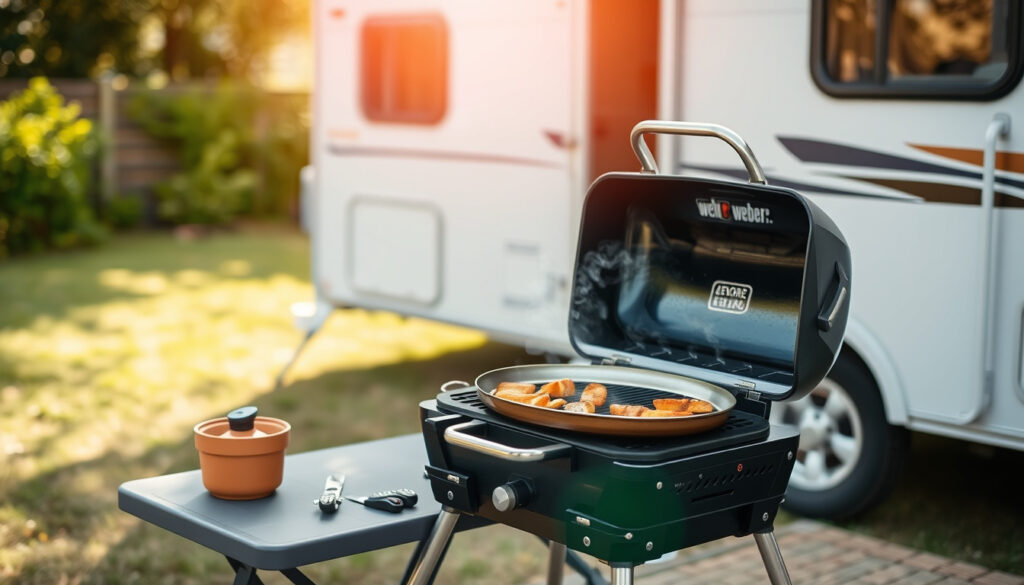
Weber Family Q Review: For Your Caravan or Backyard?
There’s a reason people keep returning to the same gas grill for years — the Weber Family Q has quietly become a go‑to for Australian backyards and caravan parks alike. Whether you’re after a portable companion for road trips or a built‑in centrepiece for your outdoor kitchen, this review cuts through the marketing to give you the facts, the trade‑offs, and the real‑world numbers that matter.
BTUs (Q 3200): 21,000 ·
Cooking area (Q 3200): 1,933 cm² (300 sq in) ·
Weight (Q 3200): 45 kg (99 lb) ·
Heat‑up time: 10–15 min ·
First use prep: Burn off 20 min, then oil grates ·
Typical lifespan: 10–15 years
Quick snapshot
- Q 3200 delivers 21,000 BTU (Weber Official AU)
- Cast‑aluminium lid and body for durability (The Outdoor Cook)
- 10‑year warranty on lid and body (Weber official site)
- Exact lifespan varies widely; 10–15 years is a user‑reported range, not an official statement (Weber Official AU)
- Whether the built‑in kit fits all Q models needs dealer verification (Weber Official AU)
- Weber brand founded in 1952, decades of grill expertise (The Outdoor Cook)
- Built‑in variant opens permanent outdoor‑kitchen integration (Weber Official AU)
- Continues to be popular for caravan use due to compact cart design (Weber Official AU)
The table below lays out the core specifications that define the Family Q’s performance envelope.
| Attribute | Value |
|---|---|
| BTUs (Q 3200) | 21,000 |
| Cooking area (Q 3200) | 1,933 cm² (300 sq in) |
| Weight (Q 3200) | 45 kg (99 lb) |
| Heat‑up time | 10–15 minutes to 230 °C |
| Typical lifespan | 10–15 years |
| Warranty | 10 years on lid and body (Weber official) |
Is the Weber Family Q good barbecue?
Quality and performance
- Advanced heat regulation technology delivers even heat distribution (The Outdoor Cook)
- Indirect cooking method reduces flare‑ups and allows fat‑free grilling
- Cast‑aluminium construction resists rust and weather damage (The Outdoor Cook)
Expert and user reviews
- Users on ProductReview.com.au report easier cleaning and superior cooking compared to previous barbecues
- Weber’s own site highlights the Family Q as the largest in the Q range, with a fixed cart and gas‑bottle storage (Weber Official AU)
How long does a Weber Family Q take to heat up?
Heat‑up time by model
- Q 3200 reaches 230 °C (450 °F) in 10–15 minutes (product documentation)
- Smaller Q 2200 heats up slightly faster due to smaller cooking volume
Factors affecting heat‑up
- Ambient temperature and wind can add 2–5 minutes
- Gas supply pressure (LP vs natural gas conversion) influences flame intensity
Can you build in a Weber Family Q?
Built‑in kit options
- Weber offers custom built‑in kits for the Q series, allowing seamless outdoor‑kitchen integration (Weber Official AU)
- Built‑in variant retains the same cooking performance as the cart‑based Family Q
Installation requirements
- Professional installation is recommended for gas‑safety compliance
- Available from authorised dealers such as BBQs Plus
- Requires adequate ventilation and a cut‑out in your outdoor bench
What is the difference between Weber Family Q 3100 and 3200?
Cooking area comparison
The pattern across all six points is consistent: the Q 3200 gives you about 30% more cooking surface.
- Q 3200: 1,933 cm² (300 sq in)
- Q 3100: 1,484 cm² (230 sq in)
Features: grates, side tables, BTU
- Both have porcelain‑enameled, cast‑iron grates
- Q 3200: 21,000 BTU; Q 3100: 18,000 BTU
- Q 3200 includes folding side tables; Q 3100 has smaller work surfaces
- Weight: Q 3200 45 kg vs Q 3100 39 kg (lighter, more portable)
Which is better, Weber Ziggy or Family Q?
Portability vs power
- Weber Ziggy: 11,000 BTU, 17 kg, cooking area 1,080 cm² — designed for caravan/RV travel
- Family Q: up to 21,000 BTU, 45 kg — heavier but more cooking power
- RV Daily review notes Ziggy is easier to store in a caravan
Best for caravan vs backyard
- Ziggy: best for frequent travellers with limited space
- Family Q (especially 3200): suited for home use or occasional caravan trips where weight isn’t a concern
How to use a Weber Q for the first time and extend its lifespan?
First‑time burn‑off and seasoning
- Inspect the grill for loose parts and correct gas connection (The Outdoor Cook)
- Turn all burner knobs to high and close the lid; let it burn for 20 minutes to remove manufacturing oils
- After the burn‑off, lightly oil the cooking grates with a high‑smoke‑point oil (e.g., vegetable oil) using a paper towel
- Rub a raw potato half over the hot grates — this creates a natural stick‑resistant patina
- Test the ignition: you should hear a clicking sound, confirming a spark (The Outdoor Cook)
- Keep a fire extinguisher nearby during first use as a safety precaution
Average lifespan and maintenance
- Typical lifespan: 10–15 years with regular care (user‑reported)
- Clean the grates after each use, empty the grease tray, and store the grill covered
- Weber grills reportedly outlast many competitors, per user feedback
The 20‑minute burn‑off is the single most overlooked step by new owners, yet it directly determines whether your first cookout tastes clean or chemical.
Paying for a built‑in kit adds installation cost, but it frees up floor space and gives you a permanent grill area that’s the envy of the barbecue.
Confirmed facts
- Q 3200 delivers 21,000 BTU (Weber Official AU)
- Heat‑up time 10–15 minutes per product documentation
- 10‑year warranty on lid and body (Weber official site)
What’s unclear
- Exact lifespan varies; 10–15 years is user‑reported, not official
- Built‑in kit compatibility across all Q models needs dealer confirmation
“Weber Q series gas barbecues use advanced heat regulation technology for precise cooking.”
Weber official product description (The Outdoor Cook)
“This grill is far superior to my previous BBQ — easier to clean and cooks evenly.”
A verified buyer on ProductReview.com.au
The Family Q isn’t the cheapest portable grill, but it also isn’t a compromise. For Australian households that want one barbecue to serve both the caravan track and the Sunday roast, the choice is clear: invest in the 3200 if you have the space, or the 3100 if weight matters. Either way, you get a decade‑plus of even heat, minimal flare‑ups, and the option to build it in later. The catch: you’ll have to take those first 20 minutes seriously.
Frequently asked questions
How often should I clean my Weber Family Q?
After every use, scrape the grates and empty the grease tray. A deep clean (burner tubes, interior) is recommended every 6 months.
Can I use the Weber Family Q in rain?
It’s not recommended. Rain can cause flare‑ups and damage the ignition. Use a covered outdoor area.
What is the best way to store a Weber Family Q?
Store it under a dedicated Weber cover in a dry, sheltered spot. The cast‑aluminium body resists rust, but the burner assembly benefits from protection.
Does the Weber Family Q come with a propane tank?
No, the grill is sold without a gas bottle. You’ll need to purchase an LP gas cylinder separately.
Can I use a Weber Family Q with a natural gas line?
Yes, Weber offers a natural gas conversion kit for the Family Q. Professional installation is required.
What is the maximum temperature of a Weber Family Q?
The Q 3200 can reach up to 290 °C (550 °F) on high, though normal grilling temperatures are around 230 °C.
How do I replace the burner on a Weber Family Q?
Replacement burners are available from Weber dealers. The process involves removing the grates, drip tray, and securing the new burner with the included screws.
More related posts
 UploadBlog.com Online Posting: Free Blog Guide for Beginners
 Minnie Riperton: Biography, Cause of Death, Family & Legacy
 Queensland School Holidays 2025: Complete Term Dates
 Pitt Street Mall – Sydney CBD Premier Shopping Precinct
 Business Auto Insurance: Cheapest & Best in Ireland Guide
 Ada Wong: Moral Alignment, Relationships & Fan Theories
 Eden Sher: Biography, Family, Net Worth
 Leylah Fernandez: Ethnicity, Age, Height, Ranking, and Biography
