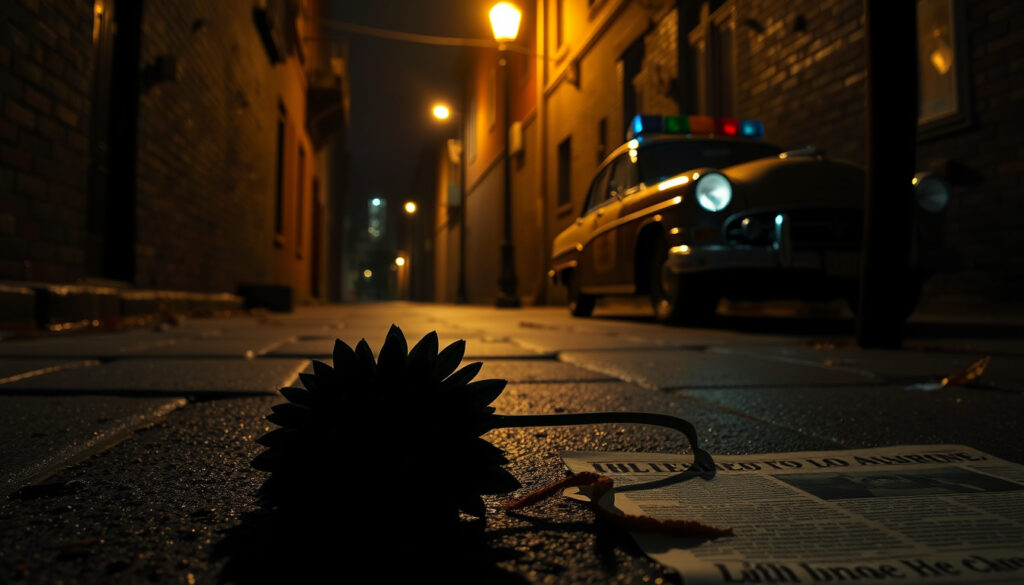
Black Dahlia Case: Facts, Theories, and Unsolved Mystery
Few murder cases have burrowed into the public imagination quite like the Black Dahlia. More than seven decades after Elizabeth Short’s body was found in a Los Angeles lot, the case remains a dark landmark of true crime culture — a story of Hollywood dreams, media frenzy, and a killer who was never caught.
Victim: Elizabeth Short ·
Date of Death: January 14–15, 1947 ·
Location: Leimert Park, Los Angeles ·
Case Status: Unsolved ·
Cause of Death: Hemorrhage from multiple wounds ·
Known For: One of the most famous unsolved murders in history
Quick snapshot
- Born July 29, 1924, in Hyde Park, Massachusetts (FBI case summary)
- Moved to California seeking a film career (FBI Vault investigation records)
- Posthumously known as the Black Dahlia (Britannica)
- Body found January 15, 1947, in Leimert Park (FBI case summary)
- Severely mutilated and bisected (FBI Vault investigation records)
- Cause of death: hemorrhage from multiple wounds (Novel Suspects case overview)
- LAPD conducted a massive investigation (FBI Vault investigation records)
- Over 60 suspects considered (Crime + Investigation timeline)
- Case remains unsolved to this day (FBI Vault violent crime)
- Fascination in true crime community (FBI case summary)
- Portrayed in films, books, and documentaries (Britannica)
- Symbol of unsolved Hollywood mystery (Novel Suspects case overview)
Here are the key facts about Elizabeth Short:
| Fact | Detail |
|---|---|
| Full Name | Elizabeth Short |
| Born | July 29, 1924 |
| Died | c. January 14–15, 1947 |
| Age at Death | 22 |
| Cause of Death | Hemorrhage from multiple wounds (homicide) |
| Case Status | Unsolved |
What does it mean to be called a Black Dahlia?
Why was Elizabeth Short called the Black Dahlia?
The nickname “Black Dahlia” was coined by the press after Elizabeth Short’s death — she never used it herself. According to the FBI case summary, the name arose from two threads: Short’s rumored preference for sheer black clothing and the 1946 film noir The Blue Dahlia. Reporters at the Los Angeles Examiner fused those elements into a moniker that stuck.
What is the connection to the movie ‘The Blue Dahlia’?
The 1946 film The Blue Dahlia, starring Alan Ladd and Veronica Lake, was a hit murder mystery set in Los Angeles. When Short’s body was found weeks later — just as the film was still fresh in public memory — journalists saw a ready-made narrative hook. The FBI case summary notes that the nickname was a press invention, not a reflection of Short’s own identity.
A young woman who died seeking fame in Hollywood became famous largely because of a nickname she never heard — invented by reporters covering a murder she never survived.
The implication: The name itself became a lens through which the public viewed the case, overshadowing the real person behind the headlines.
What was the official cause of death of the Black Dahlia?
What did the autopsy reveal?
The autopsy was performed by Dr. Frederick Newbarr, the Los Angeles County coroner. His examination documented the full extent of the injuries: Short’s body had been severed at the waist, the two halves drained of blood and deliberately posed. The FBI case summary describes the scene as one of the most brutal in LAPD history.
How was Elizabeth Short killed?
The official cause of death, as recorded by Dr. Newbarr, was hemorrhage from multiple wounds. The precise nature of the cuts led some investigators to suspect that the killer had medical training. The Novel Suspects case overview notes that the LAPD identified Short through fingerprints the day after her body was found, on January 16, 1947.
The sheer brutality and precision of the injuries created the central puzzle of the case — and fueled decades of speculation about who could have committed such a crime.
The pattern: That speculation has never been resolved, leaving the case open to endless theories.
What are some theories about the Black Dahlia?
The Dr. George Hodel theory
One of the most persistent theories implicates Dr. George Hill Hodel, a wealthy Los Angeles physician with alleged ties to the city’s underworld. Crime historian Steve Hodel, George Hodel’s son, has argued publicly that his father was the killer. However, the FBI Vault investigation records show that Hodel was investigated but never charged.
The Leslie Dillon theory
Leslie Dillon, a hotel bellhop with an interest in crime fiction, was also a suspect. He reportedly confessed under police questioning but later recanted. The Crime + Investigation timeline places Dillon among the prime suspects interrogated during the initial investigation.
The surgical precision theory
Because Short’s body was bisected with such clean cuts, many observers have assumed the killer had anatomical or surgical training. The FBI case summary does not confirm or deny this theory in its public summary, but the possibility has driven many speculative lines of inquiry over the years.
The domestic violence theory
Some researchers have proposed that Short was killed by someone she knew — perhaps a jealous lover or an acquaintance from the boarding houses where she stayed. The Novel Suspects case overview notes that Short had a pattern of staying with friends and acquaintances, making a personalized motive plausible.
The catch: Without a conviction, the theories remain just that — theories.
Have they solved the Black Dahlia?
Is the Black Dahlia case still open?
Yes — officially, the murder of Elizabeth Short has never been solved. The FBI Vault violent crime database explicitly states that the killer was never found. Despite multiple confessions, dozens of suspects, and occasional media declarations of a “breakthrough,” no legal resolution has ever been reached.
Are there recent developments?
In the 2000s, forensic teams attempted DNA testing on evidence from the case, but results were inconclusive. Independent researchers and true crime bloggers occasionally publish claims of having solved the case, but none have produced evidence that meets legal standards. The FBI case summary maintains its file as an open but cold case.
What this means: The case continues to generate interest precisely because it has no resolution.
What does a Black Dahlia symbolize?
The Black Dahlia in popular culture
The case has appeared in countless films, books, and television shows. James Ellroy’s novel The Black Dahlia, the 2006 Brian De Palma film adaptation, and the 1975 TV movie Who Is the Black Dahlia? starring Lucie Arnaz are among the best-known treatments. The Britannica entry notes that the story has become a fixture in American crime lore. For a look at another famous unsolved case, see Phil Hartman’s Death: His Children and Lasting Legacy.
Feminist interpretations
Some cultural critics have examined the Black Dahlia case through a feminist lens, arguing that the media’s focus on Short’s appearance and rumored sexual history reflected — and amplified — the misogyny of the era. The nickname itself, imposed posthumously, turned a murder victim into a sensationalized figure.
Mystique and true crime fascination
Why does this case, among thousands of unsolved murders, continue to attract attention? The FBI case summary suggests that the combination of Hollywood glamour, brutal violence, and an unsolved ending created an enduring cultural puzzle. For true crime audiences, the Black Dahlia represents the dark side of the American dream — the young woman who moved to Los Angeles seeking fame and instead found a gruesome death.
The Black Dahlia is more than a murder case — she’s a cultural symbol of the unresolved, the exploited, and the stories that refuse to fade.
The pattern: This symbolism has been reinforced by each new generation of true crime media, including shows like Criminal Minds Reid: Tragic Past, Return & JJ Relationship that explore the psychology of crime.
Who is the Black Dahlia in the 1975 true story?
What is the 1975 TV movie ‘Who Is the Black Dahlia?’?
The 1975 made-for-television film Who Is the Black Dahlia? starred Lucie Arnaz as Elizabeth Short. It dramatized the case with a focus on the investigation and the media circus surrounding it. The FBI case summary does not officially endorse any single film adaptation, but the movie is recognized as one of the earliest dramatizations of the story.
How does it compare to other adaptations?
Later adaptations — particularly Ellroy’s novel and De Palma’s film — took a darker, more psychologically complex approach. The 1975 TV movie, by contrast, was produced for a broadcast audience and treated the case with a degree of restraint. The Novel Suspects case overview notes that each era’s portrayal reflects its own cultural moment.
Early productions emphasized the sensational aspects of the case; later works tried to humanize Elizabeth Short. Neither approach has definitively answered the central question — or stopped the media machine from turning.
The implication: The case remains a cultural touchstone precisely because it resists a single narrative.
Timeline of the Black Dahlia case
Below is a chronological look at the key events in the case:
| Date | Event |
|---|---|
| July 29, 1924 | Elizabeth Short born in Hyde Park, Massachusetts (FBI case summary) |
| 1943–1946 | Short moves to California, works odd jobs, stays with friends (FBI Vault investigation records) |
| January 9, 1947 | Short last seen alive, reportedly dropped at Biltmore Hotel (Crime + Investigation timeline) |
| January 15, 1947 | Body discovered in Leimert Park, Los Angeles (FBI case summary) |
| January 16, 1947 | Autopsy performed by Dr. Frederick Newbarr, LAPD identifies Short by fingerprints (Novel Suspects case overview) |
| January 24, 1947 | Anonymous package with Short’s belongings mailed to Los Angeles Examiner (Crime + Investigation timeline) |
| January 25, 1947 | Short’s handbag and one shoe found in a dumpster (Crime + Investigation timeline) |
| 1947–1950 | Intensive LAPD investigation; multiple suspects, false confessions (FBI Vault investigation records) |
| 2000s | New forensic tests (DNA) attempted but inconclusive (FBI Vault investigation records) |
| Present day | Case remains open but unsolved (FBI Vault violent crime) |
Confirmed facts
- Elizabeth Short’s identity FBI
- Cause of death: hemorrhage from multiple wounds FBI Vault
- Body found in Leimert Park on January 15, 1947 FBI
- She sought acting career in Hollywood Novel Suspects
What’s unclear
- Identity of the killer
- Motive for the murder
- Exact timeline of her last days
- Whether killer had medical training
- Whether the killer acted alone
The pattern: The confirmed facts are few, while the unknowns are many — a recipe for endless speculation.
Key quotes and official statements
“The murder of Elizabeth Short has never been solved.”
FBI — official case summary
“The LAPD conducted one of the most exhaustive investigations in its history.”
FBI Vault — investigation records
“The case has become a defining moment in true crime culture.”
Britannica — cultural analysis
“The press invented a narrative that turned a murder victim into a legend.”
Novel Suspects — case overview
The story of Elizabeth Short is not just about a young woman who died — it’s about how a brutal murder became a cultural phenomenon. For the LAPD, it remains an open file. For the public, it’s a puzzle with no final piece. For true crime readers, the Black Dahlia is a reminder that some stories refuse to end.
timetoast.com, en.wikipedia.org, timetoast.com, truecrimeatlas.net, theblackdahliainhollywood.com, anomalydesk.com, vault.fbi.gov, theatlantic.com
Frequently asked questions
What was Elizabeth Short’s early life like?
Elizabeth Short was born on July 29, 1924, in Hyde Park, Massachusetts, and grew up in the Boston area. She moved to California in her late teens, hoping to break into the film industry (FBI).
Who was Dr. George Hodel and why is he a suspect?
Dr. George Hodel was a wealthy Los Angeles physician. His son, crime historian Steve Hodel, has argued publicly that his father was the killer. Hodel was investigated by the LAPD but never charged (FBI Vault).
What evidence was found at the Black Dahlia crime scene?
Short’s body was found in a vacant lot in Leimert Park, severed at the waist and posed. Her belongings — including a handbag and a shoe — were found days later in a dumpster (Crime + Investigation).
How did the press coverage affect the investigation?
The intense media interest created a carnival atmosphere. The Los Angeles Examiner received anonymous packages containing Short’s belongings. Some researchers argue that the coverage hindered the investigation by sensationalizing the case (Novel Suspects).
What are the most recommended books about the Black Dahlia?
James Ellroy’s The Black Dahlia (1987) is the most famous fictional treatment. Non-fiction works include John Gilmore’s Severed and Steve Hodel’s Black Dahlia Avenger (Britannica).
Is there a museum dedicated to the Black Dahlia case?
There is no permanent museum, but the case is featured in crime museums, including the Museum of Death in Los Angeles (Novel Suspects).
What is the connection between the Black Dahlia and the ‘red dahlia’ case?
There is no direct connection. The “Red Dahlia” was a nickname from an unrelated case in California. The term has occasionally been misused in media (FBI).
Have any new suspects been named in recent years?
No formal suspects have been named by law enforcement. Independent researchers periodically propose candidates, but none have led to charges (FBI Vault).
Sixty years after her death, Elizabeth Short still draws people into her story. For true crime readers, the case is a masterclass in unanswered questions. For journalists, it’s a warning about the power of a nickname. For the city of Los Angeles, it’s a shadow that never quite lifts. The Black Dahlia case will probably never be solved in a courtroom — but the fascination it generates shows no sign of fading.
More related posts
 Zootopia 2 Showtimes – Theater Times Tickets and Streaming Dates
 Connor Rozee Injury Update: Surgery, Salary & Return
 Brian Dennehy’s Death: Cause, Career, and Military Service
 Vinod Khanna: Biography, Smoking, Religion, and Cause of Death
 Wolfgang Amadeus Mozart: Facts, Myths, Life & Legacy
 Hugh Hamilton Wines – McLaren Vale Old Vine Shiraz Legacy
 Danny Frawley: Biography, Cause of Death, CTE & Legacy
 Steele Sidebottom: Real Name, Career, Retirement & Games Played
