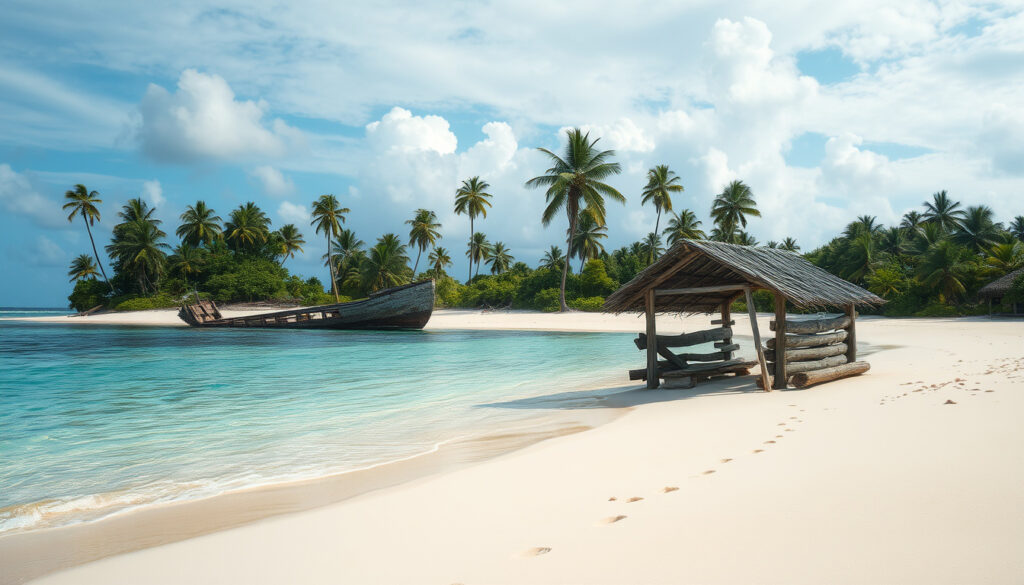
Robinson Crusoe: Summary, True Story, Importance, Reading Level
Few fictional castaways have lodged themselves in the imagination as firmly as Robinson Crusoe. Daniel Defoe’s novel, first published on 25 April 1719, turned a shipwrecked sailor’s ordeal into the template for every desert-island story that followed. Yet the book’s real legacy is more contested than its famous image suggests — and the true story behind it is even stranger.
First published: 25 April 1719 ·
Author: Daniel Defoe ·
Length (approx.): 100,000 words ·
Time on island: 28 years ·
Setting: Island near Venezuela
Quick snapshot
- Author is Daniel Defoe (Encyclopaedia Britannica)
- First published 25 April 1719 (Encyclopaedia Britannica)
- Crusoe survives a shipwreck and spends 28 years on an island (Wikipedia)
- Exact degree of Alexander Selkirk’s influence beyond general inspiration (National Geographic)
- Whether Defoe intended a specific moral allegory (World History Encyclopedia)
- Selkirk stranded 1704, rescued 1709, before the novel appeared (Encyclopaedia Britannica)
- Rogers published Selkirk’s account in 1712; novel followed in 1719 (Encyclopaedia Britannica)
- Film adaptations, from Georges Méliès in 1902 onward, keep reshaping the story (Wikipedia)
Six facts, one pattern: nearly every key date and character choice flows from Defoe’s decision to dress fiction in the clothes of a real sailor’s testimony.
| Label | Value |
|---|---|
| Author | Daniel Defoe (Encyclopaedia Britannica) |
| First published | 25 April 1719 (Encyclopaedia Britannica) |
| Genre | Adventure novel / realistic fiction (Wikipedia) |
| Setting | Island near the Orinoco River, Venezuela (National Geographic) |
| Time span in story | 28 years, 2 months, 19 days (Wikipedia) |
| Inspiration | Alexander Selkirk’s real isolation (Encyclopaedia Britannica) |
What is the story of Robinson Crusoe about?
At its simplest, the novel tells how an Englishman — against his parents’ wishes — goes to sea, gets shipwrecked, and ends up alone on an island near the Orinoco River. He builds shelter, hunts, farms, and eventually rescues a man he names Friday, all before finally leaving the island.
- Crusoe defies his parents to go to sea (Wikipedia)
- A shipwreck leaves him alone on a Caribbean island (National Geographic)
- He builds shelter, hunts, and farms for 28 years (Wikipedia)
- He rescues Friday from cannibals (Wikipedia)
- They eventually leave the island (Wikipedia)
The catch: the story that everyone remembers as a simple survival tale is actually framed as a spiritual autobiography, with Crusoe reading his ordeal as divine punishment and eventual redemption.
What illness did Robinson Crusoe have?
- In the novel, Crusoe falls violently ill with a fever during his second year on the island, a passage many readers interpret as malaria (Wikipedia)
- The illness triggers the religious crisis that runs through the middle of the book (National Geographic)
The implication: the fever is less a medical detail than a turning point — it is when Crusoe stops seeing the island as a punishment and starts treating it as a test.
Was Robinson Crusoe a true story?
No — but it was built on a widely reported real event. Scottish sailor Alexander Selkirk was left on Más a Tierra in the Juan Fernández Islands in September 1704 and rescued in February 1709, roughly 400 miles west of Valparaíso, Chile.
- Selkirk was left on Más a Tierra in September 1704 (Encyclopaedia Britannica)
- Selkirk was rescued in February 1709 by Woodes Rogers’s expedition (Encyclopaedia Britannica)
- Selkirk reportedly asked to be left after disputing the seaworthiness of his vessel (National Geographic)
- Crusoe is shipwrecked accidentally, whereas Selkirk voluntarily stayed behind (National Geographic)
Why it matters: Defoe did not copy Selkirk’s biography wholesale. Scholarly interpretations describe Robinson Crusoe as a composite influenced by multiple survival and buccaneer narratives, so the historical Selkirk story should not be treated as the novel’s sole source.
The real castaway lasted about four years and four months — not 28. Defoe stretched Selkirk’s ordeal by a factor of six to give his hero a biblical-scale sentence on the island.
Why is Robinson Crusoe so important?
The novel’s reputation rests on more than plot. It is often described as one of the earliest English novels, and its first-person, journal-style realism created a blueprint for adventure fiction that still holds.
- Often considered one of the earliest or first English novels (World History Encyclopedia)
- Introduced realistic narrative style and spiritual autobiography (National Geographic)
- Shaped themes of self-reliance and colonialism (National Geographic)
- Influenced later adventure fiction (World History Encyclopedia)
What is a famous quote from Robinson Crusoe?
One of the most cited lines from the novel is Crusoe’s reflection on his condition after the shipwreck: “I am cast upon a horrible desolate island, void of all hope of recovery.” The passage captures the book’s blend of despair and stubborn self-management.
Which Robinson Crusoe book is considered the best?
Most discussions of the “best” edition focus on the original 1719 text — the full, unadapted novel — because its archaic charm is part of the experience. Modern annotated editions from scholarly publishers are the usual recommendation for first-time readers who want context without losing Defoe’s voice.
What is the best movie version of Robinson Crusoe?
There is no consensus winner, but two landmarks stand out historically: the first known adaptation, produced by Georges Méliès in 1902, and a popular television film starring Pierce Brosnan in 1997.
- First known film adaptation: Georges Méliès, 1902 (Wikipedia)
- A later silent-film adaptation appeared in 1927 (Wikipedia)
- The 1997 TV film starred Pierce Brosnan (Wikipedia)
The pattern: each adaptation chooses which Crusoe it wants — the rugged survivor, the penitent sinner, or the colonial master. That is exactly why the novel remains contested ground.
Is Robinson Crusoe a hard read?
That depends on what you mean by “hard.” The vocabulary is early 18th-century English, and the book runs roughly 100,000 words, so it demands patience. But the prose is not academically dense; it moves at the pace of a diary.
- Written in early 18th-century English with archaic vocabulary (Wikipedia)
- Length is about 100,000 words (Wikipedia)
- Suitable for teens and adults with patience (National Geographic)
What age group should read Robinson Crusoe?
Modern classroom editions are usually assigned in middle school and high school, but the unabridged original is better suited to older teens and adults. The book’s colonial attitudes also make it a text that benefits from guidance.
What is the hardest book to read of all time?
That title is debatable — James Joyce’s Finnegans Wake and other experimental works are common candidates — but Robinson Crusoe is not in that league. Its difficulty comes from historical distance rather than stylistic complexity.
The takeaway: Crusoe is a slow book, not a hard one. The reader who gets past the first 50 pages usually finds the rhythm of the island taking over.
What is the moral of the story of Robinson Crusoe?
The overt moral is religious: Crusoe begins as a rebellious son who ignores his father’s advice, suffers for it, and finds redemption through repentance on the island. Subtler readings see a defense of self-sufficiency and a quiet endorsement of colonial superiority.
- Themes of repentance and Providence run through the novel (National Geographic)
- Crusoe’s spiritual growth moves from sinfulness to redemption (World History Encyclopedia)
- Self-sufficiency and resourcefulness are presented as virtues (National Geographic)
- The book is also read as a commentary on colonialism and cultural superiority (National Geographic)
The same novel that teaches perseverance also teaches mastery over others — Crusoe makes Friday his servant almost immediately after saving him. Modern readers have to sit with both lessons at once.
What happened to Robinson Crusoe in the end?
Crusoe returns to England after 28 years on the island, only to find that his plantation in Brazil has made him wealthy. He marries, has children, and later revisits his island in the sequel.
- Crusoe returns to England after 28 years (Wikipedia)
- He discovers his plantation has made him wealthy (Wikipedia)
- He marries and has children (Wikipedia)
- He revisits his island in a later adventure (Wikipedia)
The ending matters because it completes the arc: the island is not Crusoe’s reward but his trial. His real reward is the wealth and family he returns to — a pattern that later castaway stories flip by making the island itself the treasure.
Seven comparisons, one split: the novel and the historical record agree on the shape of the ordeal — isolation, survival, rescue — but diverge on almost every motive behind it.
| Dimension | Robinson Crusoe (novel) | Alexander Selkirk (history) |
|---|---|---|
| How it began | Accidental shipwreck (National Geographic) | Voluntarily left after a dispute with his captain (Encyclopaedia Britannica) |
| Location | Island near the Orinoco River (National Geographic) | Más a Tierra, Juan Fernández Islands (Encyclopaedia Britannica) |
| Length of isolation | 28 years (Wikipedia) | About 4 years, 4 months (Wikipedia) |
| Companion | Friday, rescued from cannibals (Wikipedia) | No equivalent companion (Encyclopaedia Britannica) |
| Spiritual arc | Sin, repentance, redemption (National Geographic) | Not part of the historical record (Encyclopaedia Britannica) |
| Rescue | English ship, then return to wealth (Wikipedia) | Rescued by Woodes Rogers, February 1709 (Encyclopaedia Britannica) |
Why this matters: the comparison is not about who “really” did what. It reveals how Defoe turned a four-year survival story into a 28-year moral examination — and how the fictional version displaced the historical one in public memory.
Upsides
- Cultural literacy: the source text for countless island-castaway references
- Historical payoff: shows how early realism developed in English fiction
- Immersive detail: the diary format makes survival feel immediate
Downsides
- Archaic language and slow pacing for modern readers
- Colonial ideology and Friday’s treatment require historical context
- Long middle section with repetitive religious reflection
Reading the original novel is a commitment, not a casual afternoon. The trade-off is that you get the genuine template — in all its complexity — rather than a cleaned-up adaptation.
Timeline signal
One arc stands out: from a real sailor’s misadventure to a continent-spanning literary brand.
| Date or period | Event |
|---|---|
| 1704 | Selkirk left on Más a Tierra (Encyclopaedia Britannica) |
| 1709 | Selkirk rescued (Encyclopaedia Britannica) |
| 1719 | Robinson Crusoe first published (Encyclopaedia Britannica) |
| 1719 | Sequel The Farther Adventures of Robinson Crusoe released (Wikipedia) |
| 19th century | Translations and adaptations spread across Europe (World History Encyclopedia) |
| 1902 | First known film adaptation directed by Georges Méliès (Wikipedia) |
| 1966 | Más a Tierra renamed Robinson Crusoe Island (Wikipedia) |
| 1997 | Popular television film starring Pierce Brosnan (Wikipedia) |
The implication: the story has been retold so often that the fictional castaway now has a real island named after him — a rare case of art conquering geography.
What we know and what we don’t
The confirmed facts about the novel are stable; the open questions are interpretive, not factual.
- Author: Daniel Defoe (Encyclopaedia Britannica)
- Publication date: 25 April 1719 (Encyclopaedia Britannica)
- Main plot details: shipwreck, 28 years, Friday, rescue (Wikipedia)
- Influence on the novel genre (World History Encyclopedia)
- Exact degree of Selkirk’s influence on Defoe (National Geographic)
- Whether Defoe intended a specific moral allegory (World History Encyclopedia)
- Historical accuracy of some island details (National Geographic)
The takeaway: readers who want certainty can find it in the publication record. Readers who want answers about Defoe’s intentions will have to accept educated interpretation.
Voices on Crusoe
“I am cast upon a horrible desolate island, void of all hope of recovery.”
Robinson Crusoe, narrator of the novel
“Scholarly interpretations describe Robinson Crusoe as a composite influenced by multiple survival and buccaneer narratives.”
National Geographic (culture and history coverage)
Both voices are needed: the narrator gives the island its emotional weight, while the critic keeps the story from being mistaken for a single, simple truth.
Summary
Crusoe’s legacy is not that he survived — it is that his survival became a mirror for whatever each generation wants the island to mean. For today’s reader, the choice is clear: read the original for its historical weight and unresolved colonial tensions, or start with an adaptation to meet Crusoe halfway — but do not mistake the adaptation for the book that started the debate.
en.wikipedia.org, jeoal.com, encyclopedia.com, reviews.rebeccareid.com
Frequently asked questions
Who is Friday in Robinson Crusoe?
Friday is a man Crusoe rescues from cannibals on the island. He becomes Crusoe’s companion and servant, and his name comes from the day of the week on which he was saved. (Wikipedia)
What is the full title of Robinson Crusoe?
The full title is The Life and Strange Surprizing Adventures of Robinson Crusoe, Of York, Mariner: Who lived Eight and Twenty Years, all alone in an un-inhabited Island on the Coast of America, near the Mouth of the Great River of Oroonoque. (Encyclopaedia Britannica)
How many years did Robinson Crusoe spend on the island?
28 years, 2 months, and 19 days. (Wikipedia)
What does the term ‘Robinsonade’ mean?
A literary genre named after Robinson Crusoe, referring to stories about a protagonist surviving alone on an island or in isolation. The pattern influenced later works like The Swiss Family Robinson and Lost. (World History Encyclopedia)
Is Robinson Crusoe the first novel in English literature?
It is often described as one of the earliest English novels, although the exact label depends on literary criteria. (World History Encyclopedia)
More related posts
 Wyatt Earp: Biography, Family, Death, and Hollywood Legacy
 Sara Waisglass: Age, Career, Relationship & Facts
 Commercial Real Estate Perth – 2024 Trends Prices and Growth
 Havana Brown: DJ and Cat Breed – Facts, Bio, and Rarity
 Manny Pacquiao v Barrio : Re ult, Pur e, and Full Recap
 Diane Kruger: Biography, Age, Family, and Career Facts
 Melissa McCarthy Weight Loss: Facts vs. Ozempic Rumors
 Richard Dreyfuss: Bipolar Disorder, Medication & Advocacy
