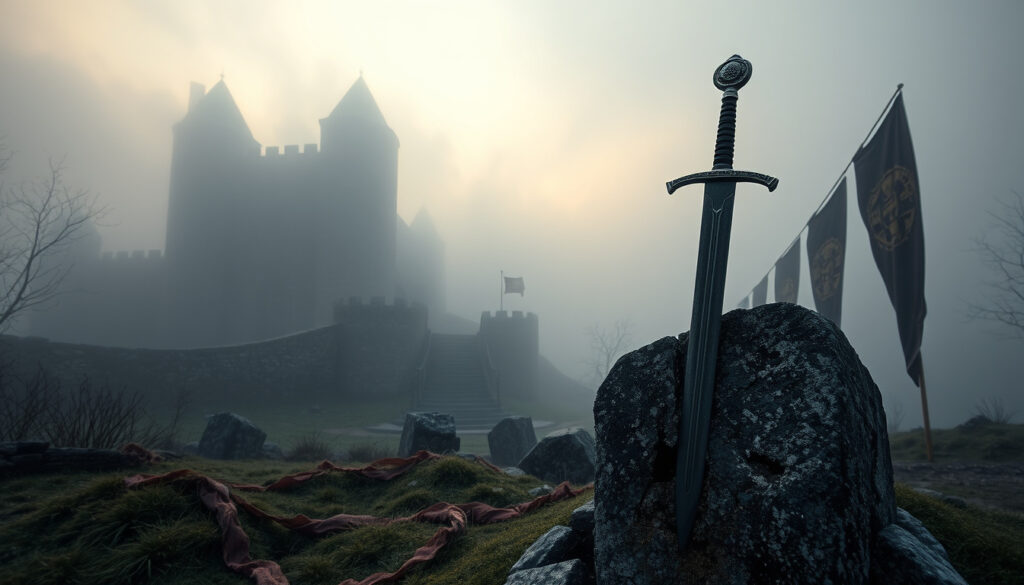
King Arthur: Legend or History? Facts & Myths
Few names in British folklore carry as much weight as King Arthur—but the line between history and legend has blurred for over a thousand years. While archaeologists have turned up sixth-century luxury goods at Tintagel and refortified hillforts at South Cadbury, no contemporary text from Arthur’s supposed lifetime mentions him. This article traces what the earliest sources actually say and where the evidence leaves us.
First written mention: c. 830 CE in Historia Brittonum ·
Primary literary source: Le Morte d’Arthur by Thomas Malory (1485) ·
Number of known medieval manuscripts: over 200 ·
Modern film adaptations since 1900: more than 30
Quick snapshot
- Arthur first appears in the 9th-century Historia Brittonum (Wikipedia (reference compendium))
- Geoffrey of Monmouth’s 12th-century work shaped the legend (BBC History (public broadcaster))
- Malory’s 1485 compilation is the primary source for modern retellings (British Library (national library))
- Whether a real 5th–6th century leader named Arthur existed (BBC History (public broadcaster))
- Precise location of Camelot or Avalon (The Independent (UK news outlet))
- Authenticity of Glastonbury’s 1191 grave claim (Smithsonian Magazine (historical magazine))
- c. 830 CE – First written mention in Historia Brittonum (legendofkingarthur.co.uk (specialist site))
- c. 1136 – Geoffrey of Monmouth popularises Arthur (British Library (national library))
- 1191 – Glastonbury Abbey claims Arthur’s tomb (Smithsonian Magazine (historical magazine))
- Ongoing excavations at Tintagel and Cadbury Castle continue to reveal post-Roman activity (WOUB (PBS affiliate))
- New studies of early Welsh poetry may clarify the Arthurian tradition (University of Bristol (academic research))
The five rows below show the gap between literary fame and historical silence.
| Attribute | Value |
|---|---|
| Earliest written source | Historia Brittonum (c. 830 CE) |
| Major literary codifier | Sir Thomas Malory, Le Morte d’Arthur (1485) |
| Key symbol | Excalibur, the mythic sword |
| Associated location | Camelot (legendary), Tintagel, Glastonbury |
| Historical period | Post-Roman Britain (5th–6th century CE) |
Was King Arthur real or a legend?
Earliest textual references
- The earliest surviving near-contemporary Brittonic source, Gildas, does not name Arthur. Instead Gildas names Ambrosius Aurelianus as a British leader (BBC History (public broadcaster)).
- The first definite mention of Arthur appears in the early 9th-century Historia Brittonum, where he is presented as a dux bellorum fighting Saxons in twelve battles (Wikipedia (reference compendium)).
- The Annales Cambriae contains entries linking Arthur to the Battle of Badon and the Battle of Camlann (legendofkingarthur.co.uk (specialist site)).
Archaeological clues from post-Roman Britain
- Tintagel in Cornwall has produced sixth-century material, including a slate inscription with the name Artognou—similar to Arthur but not identifying him directly (Archaeology Magazine Archive (archaeological publication)).
- Excavations at South Cadbury by Leslie Alcock found heavy refortification in the 5th–6th centuries, though no link to Arthur (The Independent (UK news outlet)).
Bottom line: The historical Arthur remains unconfirmed. No contemporary 5th–6th century source names him, leaving a figure whose legend dwarfs the evidence. For historians the conclusion is clear: Arthur is a legendary figure with a possible historical core, not a proven ruler.
What was King Arthur most known for?
Leadership of the Knights of the Round Table
- Central figure in the Matter of Britain literary tradition, Arthur embodies ideal kingship and chivalry (Oxford Reference (academic reference work)).
- The Round Table symbolises equality among knights and first appears in Wace’s Roman de Brut (1155) (popular tradition, cited by British Library (national library)).
The sword Excalibur
- Excalibur is the mythic sword of Arthur, often presented as a symbol of rightful sovereignty (British Library (national library)).
- The sword-from-the-stone episode appears in Robert de Boron’s Merlin (c. 1200) and later in Malory (common Arthurian motif).
The quest for the Holy Grail
- The Grail quest becomes a central theme in 13th-century prose romances, especially the Vulgate Cycle (Oxford Reference (academic reference work)).
The implication: Arthur’s fame rests almost entirely on literary elaboration, not historical record. The stories that define him—the Round Table, Excalibur, the Grail—were added centuries after his supposed lifetime.
Where was King Arthur in England?
Tintagel Castle in Cornwall
- Tintagel is strongly associated with Arthur’s conception in Geoffrey of Monmouth’s Historia Regum Britanniae (c. 1136) (BBC History (public broadcaster)).
- Archaeology confirms a high-status post-Roman settlement with imported Mediterranean pottery (WOUB (PBS affiliate)).
Glastonbury Abbey
- In 1191, monks claimed to have discovered Arthur’s tomb between two pyramids—a story widely considered a publicity stunt to attract pilgrims (Smithsonian Magazine (historical magazine)).
Camelot locations
- Camelot is often linked to Cadbury Castle in Somerset or Winchester Castle (BBC History (public broadcaster)).
- Neither site can be securely identified as Camelot; the name first appears in Chrétien de Troyes’ Lancelot (c. 1170) (common literary reference).
What this means: The places tied to Arthur are real archaeological sites with 5th–6th century occupation, but their Arthurian connections come from later medieval invention, not contemporary evidence.
Did King Arthur forgive his wife?
The affair of Lancelot and Guinevere
- In most versions, Arthur was unaware of the affair until near the end of his reign (British Library (national library)).
- He ordered Guinevere to be burned at the stake for treason, but Lancelot rescued her—a key episode in Malory (Le Morte d’Arthur, Book XX).
Arthur’s response in Malory’s Le Morte d’Arthur
- Arthur never explicitly forgives Guinevere in traditional texts. After the rescue, he pursues Lancelot to France, leaving Britain vulnerable to Mordred’s revolt (Oxford Reference (academic reference work)).
The trade-off: Arthur’s kingship demanded justice for betrayal, but his response triggered the fall of Camelot. Forgiveness would have broken the code of honour that defined his reign.
The king who symbolises chivalry and justice could not pardon the one betrayal that mattered most. His adherence to the code, not mercy, defines the tragic end.
Why was King Arthur killed?
Battle of Camlann
- Arthur died after the Battle of Camlann, fighting Mordred (legendofkingarthur.co.uk (specialist site)).
- The Annales Cambriae entry for 537 records “the strife of Camlann, in which Arthur and Mordred fell” (cited by Wikipedia (reference compendium)).
Betrayal by Mordred
- Mordred is portrayed as Arthur’s son (by his half-sister Morgause) or nephew—a figure of treachery in most versions (common medieval motif).
- Arthur’s body was taken to Avalon after Camlann, according to Geoffrey of Monmouth (British Library (national library)).
The pattern: Arthur’s death is a direct consequence of his own actions in response to Guinevere’s betrayal. The internal collapse of the Round Table, not external invasion, destroys him.
The story of Arthur’s death resonated because it turned a military defeat into a moral tragedy. For medieval audiences, the lesson was clear: even the greatest king falls when his court is divided.
Confirmed facts and what remains unclear
Confirmed facts
- Arthur first appears in 9th-century text Historia Brittonum (Wikipedia (reference compendium))
- Geoffrey of Monmouth’s 12th-century work shaped the legend (BBC History (public broadcaster))
- Malory’s 15th-century compilation is the primary source for most modern retellings (British Library (national library))
What’s unclear
- Whether a real 5th–6th century leader named Arthur existed (BBC History (public broadcaster))
- Precise location of Camelot or Avalon (The Independent (UK news outlet))
- Authenticity of Glastonbury’s 1191 grave claim (Smithsonian Magazine (historical magazine))
Voices from the sources
“Arthur fought against the Saxons alongside the kings of the Britons, but he himself was leader of battles.”
— Nennius, 9th-century Welsh monk, Historia Brittonum (paraphrased by University of Bristol (academic research))
“Geoffrey of Monmouth’s History of the Kings of Britain made Arthur a world figure, but it was largely fiction.”
— BBC History (public broadcaster)
“Malory’s Le Morte d’Arthur remains the definitive version of the Arthurian story, combining earlier French and English romances.”
— British Library (national library)
For anyone trying to distinguish fact from fiction in the Arthurian tradition, the choice is clear: treat the legend as a literary mirror of medieval ideals, not sixth-century history, or accept the absence of proof as part of the myth itself.
Related reading: **Jesus Christ: Facts, Teachings, and Common Questions**
Frequently asked questions
Was King Arthur real or a legend?
Historians classify Arthur as a legendary figure with a possible historical core. No contemporary 5th–6th century source names him (BBC History).
What was King Arthur most known for?
He is known as the central figure of the Matter of Britain literary tradition, associated with the Knights of the Round Table, the sword Excalibur, and the quest for the Holy Grail (British Library).
Why was King Arthur killed?
Arthur died after the Battle of Camlann fighting Mordred, who betrayed him while Arthur was pursuing Lancelot (legendofkingarthur.co.uk).
Did King Arthur forgive his wife?
In Malory’s Le Morte d’Arthur, Arthur never explicitly forgives Guinevere. He orders her execution for adultery, though Lancelot rescues her (Oxford Reference).
Where was King Arthur in England?
Arthur is associated with Tintagel Castle (Cornwall), Glastonbury Abbey, and legendary Camelot. Tintagel and Cadbury Castle show post-Roman activity but no direct link to Arthur (BBC History).
What is the historical evidence for King Arthur?
The first written mention is in the 9th-century Historia Brittonum. Archaeology shows elite post-Roman activity at Tintagel and Cadbury, but no inscription or artifact names Arthur (Archaeology Magazine).
Who was Queen Guinevere in Arthurian legend?
Guinevere is Arthur’s queen and the wife whose affair with Sir Lancelot triggers the downfall of Camelot. Her role appears in nearly all Arthurian romances (British Library).
What is Excalibur in the King Arthur story?
Excalibur is the legendary sword of Arthur, often associated with magical origins and the right to rule. It appears first in the Vulgate Cycle (13th century) and becomes a central symbol (Smithsonian Magazine).
More related posts
 Bonnie Hunt: Biography, Career, Net Worth, and Personal Life
 Cyrell Paule: Career, Relationships, Baby, and Net Worth
 Marty Reisman: The Real Story Behind ‘Marty Supreme’
 Danny Frawley: Biography, Cause of Death, CTE & Legacy
 Wolfgang Amadeus Mozart: Facts, Myths, Life & Legacy
 Child Support Calculator Ireland: Estimate Payments Online
 Max Chandler-Mather: Biography, Net Worth, Partner, Current Role
