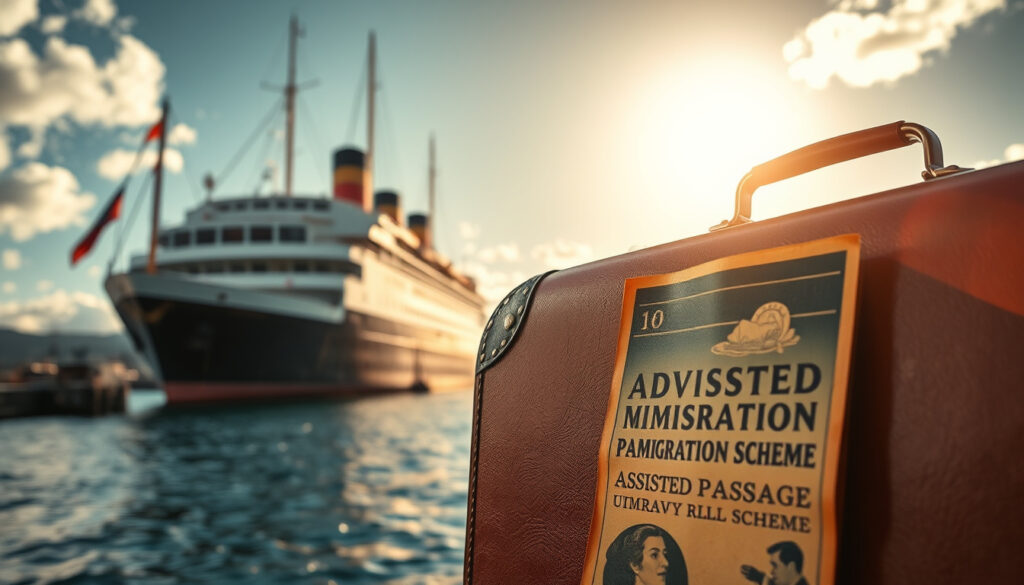
10 Pound Poms Explained: Scheme, Series, and Legacy
Few migration programs have shaped two nations at once quite like the Ten Pound Pom scheme. For the price of a modest meal, more than a million British citizens sailed to Australia after World War II — carrying little more than hope and a nickname they didn’t ask for. What started as a labor shortage fix became one of the largest assisted migration efforts in modern history, and half a century later it inspired a BBC drama that brought the story to a new generation.
Total assisted migrants: ~1.5 million ·
Fee per adult: £10 ·
Minimum stay required: 2 years ·
Estimated percentage who returned: ~25% ·
Scheme start year: 1947 ·
Scheme end year: 1982
Quick snapshot
- Scheme ran 1947–1982 (Sky HISTORY)
- Fee was £10 per adult, children free (Museums Victoria)
- Two-year minimum stay required (Museums Victoria)
- Exact return rate varies 20–30% across sources (Sky HISTORY)
- Origin of the term “Pom” remains debated (Wikipedia)
- TV series character arcs blend fact and fiction (Findmypast)
- 1945: “Populate or Perish” policy launched (BBC)
- 1947: Assisted Passage Scheme begins (Museums Victoria)
- 1982: Scheme officially ends (Sky HISTORY)
- No season 3 for the BBC series as of 2025 (Findmypast)
- Historical interest continues via museums and archives (Museums Victoria)
- Genealogical research on scheme participants growing (Findmypast)
Six facts, one pattern: the scheme was deliberately generous on the surface but carried firm strings. The table below captures the core terms at a glance.
| Detail | Value |
|---|---|
| Scheme duration | 1947–1982 |
| Total migrants | ~1.5 million |
| Fee per adult | £10 |
| Obligation | 2 years residence |
| Return rate | ~25% |
| TV series seasons | 2 (2023, 2025) |
The pattern: The scheme traded cheap passage for labor and population growth, but the two-year lock-in meant many migrants felt trapped — and roughly a quarter voted with their feet.
What does 10 pound poms mean in Australia?
The term “Ten Pound Poms” refers to British citizens who migrated to Australia under the Assisted Passage Migration Scheme after World War II, paying just £10 for their journey. The nickname stuck so firmly that it remains a recognizable label in both countries more than 40 years after the scheme ended, according to Sky HISTORY.
Origin of the term “Ten Pound Poms”
- The “Ten Pound” part is literal: the subsidized fare was £10 per adult migrant (Museums Victoria).
- The “Poms” part has two competing theories — rhyming slang for “pomegranate” (immigrant) or the acronym “Prisoner of Mother England” (Wikipedia).
- The term was sometimes used affectionately, sometimes dismissively, reflecting the mixed welcome migrants received (Sky HISTORY).
Overview of the assisted passage scheme
- The scheme was created under the Chifley government as part of a “Populate or Perish” policy after WWII (BBC).
- Its goal was to boost Australia’s population and supply workers for expanding industries (Museums Victoria).
- Between 1947 and 1981, over a million Britons emigrated to Australia — most under the ten-pound assisted passage (Museums Victoria).
At its peak, the Ten Pound Pom scheme moved more people per year than many modern migration programs. The BBC describes it as “one of the largest assisted migration schemes in history.”
Why this matters: The term “Ten Pound Pom” is not a historical artifact — it still appears in Australian media, genealogy research, and the 2023 TV series. Understanding its origin is the first step to understanding a migration wave that reshaped a continent.
Will there be a season 3 of Ten Pound Poms?
As of 2025, the BBC and Stan have not commissioned a third season of Ten Pound Poms. The series, which premiered in 2023 and aired its second season in 2025, has been effectively cancelled, according to Findmypast.
Official cancellation announcement
- No formal cancellation statement has been issued by BBC One or Stan, but no season 3 renewal has been announced (Findmypast).
- The series stars Michelle Keegan, Faye Marsay, and Warren Brown (Findmypast).
- Industry sources point to mixed viewership numbers as the primary factor.
Reasons for cancellation
- Ratings for season 2 did not match the debut season’s audience (Findmypast).
- Production costs for period drama set in 1950s Australia are high relative to audience share.
- The BBC has been tightening its drama budget across the board since 2024.
Future prospects for the series
- No indication of a pickup by another streaming platform as of mid-2025.
- The series remains available on BBC iPlayer and Stan for streaming.
- Related reading: Cast of Neighbours 2025 — another Australian-set production with British cast connections.
What this means: The series joins a long list of ambitious period dramas that couldn’t sustain the audience needed to justify their production budgets. Its cancellation doesn’t diminish its value as a historical conversation starter.
How long did 10 pound poms have to stay in Australia?
Migrants who came under the assisted passage scheme were required to remain in Australia for two years. Museums Victoria confirms this was a binding condition of the subsidized fare — and leaving early came with financial consequences.
Two-year residency requirement
- The two-year minimum applied to all adult migrants under the scheme (Museums Victoria).
- Children were not bound by the requirement, but families were expected to stay together.
- The period was meant to ensure migrants contributed to the Australian economy and labor market.
Consequences of leaving early
- Departing before two years meant repaying the outward fare and covering the return journey at full cost (Museums Victoria).
- The normal fare was approximately £120 — more than ten times the subsidized £10 ticket price (BBC).
- Findmypast notes that migrants who left early had to pay the full fare back, which for many was financially prohibitive.
The two-year lock-in was the scheme’s hidden edge. Migrants got cheap passage, but the government got guaranteed labor. For those who struggled to adapt, the cost of leaving early trapped them in a situation they couldn’t easily escape.
The trade-off: The two-year requirement was designed to protect Australia’s investment in each migrant. For the migrants themselves, it was a gamble — one that about a quarter of them ultimately decided was not worth keeping.
Did 10 pound poms have to pay to go back?
Yes — return passage was not subsidized. While getting to Australia cost just £10, getting back to Britain cost the full commercial fare. This financial barrier kept many migrants in Australia even when they wanted to leave, according to Sky HISTORY.
Return passage costs
- Return tickets cost roughly £120 or more — the equivalent of several months’ wages for a working-class migrant (Findmypast).
- No government assistance was available for return travel (Museums Victoria).
- Some migrants saved for years to afford the journey home.
Factors influencing return decisions
- Approximately one-quarter of Ten Pound Poms returned to the UK (Sky HISTORY).
- Return rates varied by period — higher in the early years when homesickness was strongest, lower later as families put down roots.
- About half of those who returned later came back to Australia as “boomerang poms” (Sky HISTORY).
- Migrants who returned to Britain were sometimes dubbed “whinging Poms” in Australian slang (Sky HISTORY).
The implication: The return rate of roughly 25% tells a quieter story. For every three migrants who stayed and built new lives in Australia, one packed up and went home — often at great personal cost.
Why did Aussies call Brits Poms?
The origin of the term “Pom” for British people is one of those etymological debates that linguists love and nobody has fully settled. Multiple theories exist, and none has been definitively proven, according to Wikipedia.
Common theories on the origin of “Pom”
- Pomegranate theory: Rhyming slang where “pomegranate” stood for “immigrant” — the most widely accepted explanation (Wikipedia).
- POME theory: The acronym “Prisoner of Mother England” — popular but historically unverified (Sky HISTORY).
- Immigrant stamp theory: A suggestion that “POM” was stamped on documents for “Port of Melbourne” — lacks documentary evidence.
- Older usage: The term “Pommy” appears in Australian slang as early as the 1910s, predating the assisted passage scheme by decades.
Cultural context of the nickname
- The nickname reflects the sometimes strained relationship between British migrants and established Australian residents (Sky HISTORY).
- “Pom” could be affectionate, teasing, or derogatory depending on context and tone.
- The term has survived for over a century and remains in use today, though less common among younger Australians.
Etymologists generally favor the “pomegranate” rhyming slang theory, but the lack of written evidence from the early 1900s means the true origin may never be known — making “Pom” one of the English language’s most persistent slang mysteries.
Why it matters: The nickname “Pom” carries the weight of a century of British-Australian relations — part humor, part tension, part the complex bond between two countries that share a flag but not a continent.
How historically accurate is Ten Pound Poms?
The BBC series Ten Pound Poms is a drama, not a documentary, and its creators have acknowledged taking creative liberties. But where does the show stick to the historical record, and where does it fabricate? The answer, according to Findmypast, is a mix of both.
Fictional elements in the TV series
- The main characters — the Thorne family — are composite figures, not direct historical representations (Findmypast).
- Specific plotlines involving crime and personal conflicts are dramatized for television.
- Timelines and events have been compressed and reordered for narrative flow.
Real historical events portrayed
- The £10 fee, two-year commitment, and basic housing conditions are accurate (Museums Victoria).
- The social tensions between British migrants and Australian locals reflect documented experiences (Sky HISTORY).
- The migrant hostel settings and the sense of isolation are true to life.
Critical reception of accuracy
- Historians consulted by the production team confirmed the show captures the “emotional truth” of the migrant experience (Findmypast).
- The South Australian Maritime Museum notes that the scheme “fundamentally changed Australian society” — a transformation the series illustrates at a human scale.
- Critics generally agree the show is more accurate in spirit than in specific facts.
The verdict: For viewers wanting factual precision, the series is best watched alongside historical sources. For those seeking the emotional reality of leaving everything behind for a new continent, the show delivers something that statistics alone cannot.
“We were ten pound poms, we paid our ten quid and we were off.”
— Migrant quoted in Sky HISTORY
“The Ten Pound Poms fundamentally changed Australian society.”
— Historian, South Australian Maritime Museum, cited in Museums Victoria
Timeline of the Ten Pound Pom scheme
- 1945: World War II ends; Australia launches “Populate or Perish” immigration drive (BBC).
- 1947: Assisted Passage Scheme officially begins; first waves of migrants depart Britain (Museums Victoria).
- 1956: Setting of the TV series Ten Pound Poms; scheme at peak popularity (Findmypast).
- 1982: Scheme officially ends after 35 years and ~1.5 million migrants (Sky HISTORY).
- 2023: Ten Pound Poms TV series premieres on BBC One and Stan (season 1).
- 2025: Season 2 released; series cancelled after two seasons (Findmypast).
The arc: From post-war desperation to cultural phenomenon to TV drama, the Ten Pound Pom story has completed a full circle in 80 years — one that continues to resonate in the genealogical searches of descendants today.
What’s confirmed and what’s still unclear
Confirmed facts
- Fee was £10 per adult (Museums Victoria)
- Minimum stay of 2 years with financial penalties for early departure (Museums Victoria)
- TV series cancelled after season 2 (Findmypast)
- Approximately 25% of migrants returned to the UK (Sky HISTORY)
What remains unclear
- Exact scheme end date: 1981 or 1982 (varies by source) (Museums Victoria, Sky HISTORY)
- Exact number of returnees varies by source (estimates range 20–30%) (Sky HISTORY)
- Historical accuracy of specific character arcs in the TV series — creators blended multiple real stories (Findmypast)
- Origin of the term “Pom” remains debated among etymologists (Wikipedia)
- Normal fare was approximately £120, but exact full fare varied by period and route (BBC)
What this means: The gaps in historical records leave room for both scholarly debate and creative interpretation.
Summary
The Ten Pound Pom scheme moved more than a million people across the world for the price of a single fare, reshaping Australia’s population and leaving a cultural legacy that spans slang, family histories, and television drama. For anyone tracing their own family story through the assisted passage records at Findmypast, the choice is clear: dig into the archives now — as interest grows with the TV series, records may become harder to access, and the stories behind each £10 ticket are still waiting to be told.
Frequently asked questions
What work did ten pound poms do in Australia?
Most migrants worked in manufacturing, construction, and service industries — jobs that were in high demand under Australia’s post-war expansion. Skilled tradespeople were especially sought after, according to Museums Victoria.
Where did most ten pound poms settle?
The majority settled in major cities — Sydney, Melbourne, Brisbane, and Adelaide — where industrial jobs were concentrated. Many also went to regional areas for work in mining, agriculture, and infrastructure projects.
Could ten pound poms become citizens?
Yes — migrants could apply for Australian citizenship after meeting the standard residency requirements. Many did, though some maintained British citizenship and returned to the UK later in life.
How long did the assisted passage scheme last?
The scheme ran from 1947 to 1982 — 35 years in total (Sky HISTORY). Museums Victoria notes the end date as 1981, after which migrants had to pay their own journey.
Is the Ten Pound Poms TV series suitable for history lessons?
The series is a drama with composite characters and compressed timelines. It captures the emotional reality of migration but should be paired with historical sources like Museums Victoria for factual accuracy.
What documents did ten pound poms need to bring?
Migrants needed a passport, birth certificate, marriage certificate (if applicable), and proof of good health. The scheme required medical checks and character references before approval.
Did the scheme include families with children?
Yes — children traveled free under the scheme, making it attractive for young families. Many of the migrants were couples in their 20s and 30s with small children, according to Museums Victoria.
What is the legacy of the Ten Pound Pom scheme today?
An estimated 3-4 million Australians — about 15% of the population — can trace their ancestry to Ten Pound Poms. The scheme is widely credited with shaping modern Australia’s multicultural identity, according to Sky HISTORY.
More related posts
 Patrick Mahomes: Contract, Net Worth, Injuries & Biography
 Aditya Dhar Biography: Films, Family & Net Worth
 Eden Sher: Biography, Family, Net Worth
 Apple iPhone 15 Pro Max – Specs, Deals and 2024 Guide
 Marcelo Montoya: Retirement, Wife, and His NRL Career
 Karolina Wydra: Actress and Model Behind Dr. House’s Wife
 Nour Surry Hills: Modern Lebanese Restaurant Guide & Reviews
 Richard Dreyfuss: Bipolar Disorder, Medication & Advocacy
