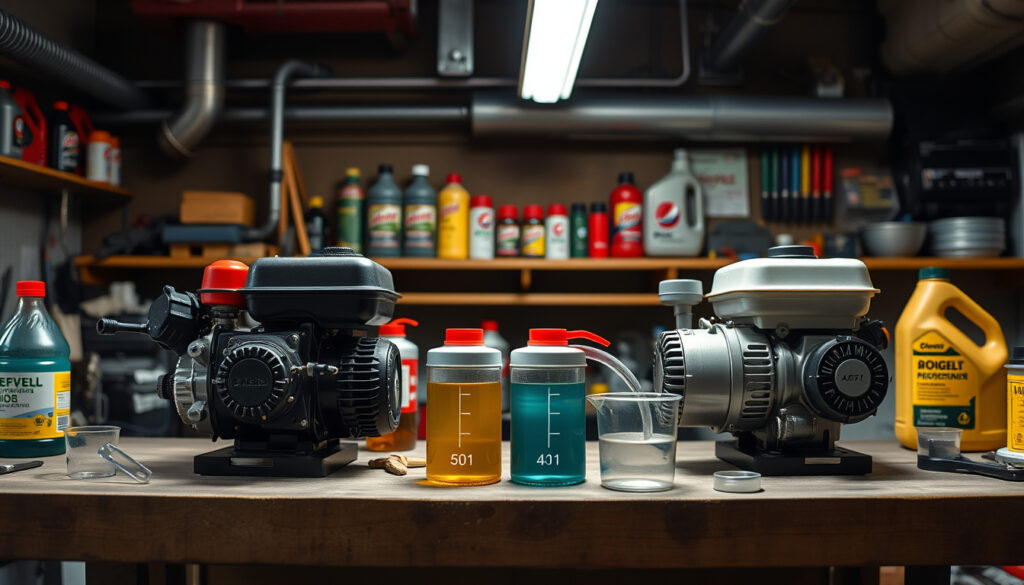
2 Stroke Oil: Mix Ratios, Types & 2 vs 4 Stroke Guide
If you’ve ever pulled a cord on a chainsaw, scooter, or garden trimmer and wondered what’s actually keeping the engine alive, the answer usually comes down to one thing: 2 stroke oil. These engines run on a fuel-oil mixture rather than splash-lubricated sumps, which means getting the ratio right isn’t optional—it’s the difference between a running motor and a seized one.
Typical Mix Ratio: 50:1 · Suitable Engines: Mopeds, scooters, garden tools · Key Additive: Semi-synthetic base · Volume Options: 1L, 5L · Common Brands: Comma, Maxol, Gem
Quick snapshot
- 50:1 ratio requires 20ml oil per litre (Cub Cadet oil ratio guide)
- Husqvarna mandates 50:1 for products up to 75cc (Husqvarna US mixing guide)
- Tohatsu outboards require 50:1 premix (TOHATSU North America technical info)
- Exact shelf life without professional testing remains unverified by manufacturers
- Performance data from independent tests on specific ratios is limited
- Global regulatory standards outside California have not been standardised
- Pre-2003 Cub Cadet handheld: 32:1 ratio
- Post-2002 Cub Cadet handheld: 40:1 ratio
- California mandated 40:1 for certain 2-cycle handheld equipment
- Always check the owner’s manual for the exact ratio before mixing
- Manufacturer guidelines take precedence over generic charts
- Premium synthetic 2-stroke oils are replacing mineral blends in newer equipment
These figures summarise the most widely applicable 2-stroke fuel-oil specifications from major manufacturers.
| Label | Value |
|---|---|
| Primary Use | 2-stroke petrol engines |
| Mix Method | Premix or injected |
| Shelf Life | Avoid 20+ years old |
| Top Retailers | Halfords, Screwfix |
| 50:1 Oil per Litre | 20 ml |
| 50:1 Oil per US Gallon | 2.6 oz |
| 40:1 Oil per US Gallon | 3.2 oz |
| 32:1 Oil per US Gallon | 4 oz |
| 40:1 Oil per 5L Fuel | 125 ml |
| Power Stroke (2-stroke) | 1 crankshaft revolution |
What oil can you use for a 2-stroke?
The most suitable oils for 2-stroke engines are specifically formulated semi-synthetic blends that readily mix with petrol and burn cleanly during combustion. These oils are designed for air-cooled engines found in mopeds, scooters, garden tools, and handheld equipment—never substitute automotive motor oil, which lacks the necessary detergent and burning properties (2 Stroke Mix Calculator fuel chart).
Recommended types
Three main categories dominate the market. Mineral oils represent the budget-friendly option for low-intensity use. Semi-synthetic oils offer a middle ground with better protection and cleaner burn—ideal for regular garden work. Fully synthetic oils provide maximum engine protection, better for high-revving dirt bikes and marine outboards.
Semi-synthetic options
Semi-synthetic 2-stroke oils balance cost and performance for most consumer applications. Brands like Comma, Maxol, and Gem offer semi-synthetic formulations in 1L and 5L volumes, readily available from retailers including Halfords and Screwfix. These blends incorporate additive packages that improve lubrication stability and reduce carbon deposits.
What is the mix for two-stroke oil?
Mixing ratios express the fuel-to-oil proportion as a ratio—50:1 means 50 parts fuel to 1 part oil. Most modern equipment targets either 50:1 or 40:1, though older machines and specific applications may require 32:1 or tighter. The ratio determines how much oil enters the combustion chamber with each stroke.
Standard ratios
Three ratios cover the vast majority of consumer 2-stroke applications. At 50:1 (the modern standard for chainsaws, dirt bikes, outboards, and weed trimmers), you add 2.6 ounces of oil per US gallon of fuel (AMSOIL universal ratio guide). At 40:1 (the post-2002 standard for many handheld tools and California requirements), that rises to 3.2 ounces per gallon. At 32:1 (still found in pre-2003 Cub Cadet handheld equipment), you use 4 ounces per gallon (Cub Cadet ratio maintenance guide).
Per litre calculations
For metric measurements, the math is straightforward. At 50:1, add 20ml of oil per litre of fuel—meaning 100ml per 5L jerry can. At 40:1, that increases to 125ml per 5L fuel. Mixing becomes simpler when you pre-measure into a graduated container before filling the fuel tank.
Too much oil—say running a 40:1 mix in a 50:1 engine—generates excess smoke and carbon buildup but typically causes no permanent damage. Too little oil starves lubrication, leading to overheating, piston seizure, and catastrophic engine failure. When in doubt, lean slightly rich rather than lean.
Is 2-stroke and 4-stroke oil different?
The differences between 2-stroke and 4-stroke engines run deeper than just oil type—they reflect fundamentally different mechanical designs. A 2-stroke engine completes its power cycle in one crankshaft revolution, firing every 360 degrees, whereas a 4-stroke engine requires two revolutions and fires every 720 degrees (BYJU’S physics comparison). This architectural difference shapes everything from lubrication method to emissions profile.
Lubrication methods
2-stroke engines use fuel-oil premix or oil injection—the oil travels into the combustion chamber with the fuel, meaning it burns along with the mixture. 4-stroke engines maintain a dedicated oil sump; the oil lubricates internal components and returns to the pan, remaining relatively cool and reusable. A 4-stroke cannot share lubrication duties with a 2-stroke system because the 2-stroke relies on oil being present in the combustion chamber itself (Valvoline Global lubrication explainer).
Additive differences
2-stroke oil additives emphasise clean burning and combustion compatibility, reducing spark plug fouling and exhaust port blocking. 4-stroke additives focus on film strength, oxidation resistance, and temperature tolerance within a closed sump. Using 4-stroke oil in a 2-stroke engine will cause sluggish performance, carbon accumulation, and potential engine damage.
What this means: the two oil types are chemically incompatible for each other’s systems, and substituting one for the other invites mechanical failure.
The following table highlights the key mechanical and operational differences between these engine types.
| Feature | 2-stroke | 4-stroke |
|---|---|---|
| Power strokes per revolution | 1 (every 360°) | 0.5 (every 720°) |
| Fuel inlet/outlet method | Ports | Valves |
| Lubrication | Fuel-oil premix | Separate sump |
| Compression ratio | Lower (~5.9:1) | Higher (~9.5:1) |
| Power-to-weight | Higher | Lower |
| Typical applications | Chainsaws, dirt bikes, outboards | Cars, trucks, riding mowers |
| Emissions | More smoke | Cleaner burn |
| Thermal efficiency | Lower | Higher |
Does it matter what brand of 2-stroke oil I use?
Quality matters more than brand prestige in 2-stroke oil selection, though recognised manufacturers consistently outperform generic alternatives. High-performance synthetic 2-stroke oils like AMSOIL SABER can safely extend to 100:1 ratios, offering both protection and reduced emissions (AMSOIL universal ratio guide). The key is verifying that the product meets international standards for 2-cycle engine lubrication.
Quality factors
When evaluating 2-stroke oil brands, look for JASO FC or ISO EGC ratings—the international standards for ashless, low-smoke formulations. These certifications indicate the oil burns cleanly enough to minimise exhaust port carbon buildup and spark plug fouling. Quality additives also protect against piston crown deposits and ring sticking during extended operation.
Manufacturer matches
Major tool manufacturers like Husqvarna specify particular performance tiers for oils used in their products. While any oil meeting the JASO FC standard generally suffices, using a manufacturer-recommended brand streamlines warranty claims and ensures compatibility with specific engine designs. Tohatsu mandates 50:1 premix for all their 2-stroke outboards (TOHATSU North America outboard specs), underscoring how brand-specific requirements can vary.
Generic oils without JASO certification may satisfy the minimum ratio requirement but will leave your engine vulnerable to carbon deposits and reduced longevity. For equipment you depend on—your primary chainsaw or weekend dirt bike—spending slightly more on a tier-1 or tier-2 brand from AMSOIL, Castrol, or Valvoline delivers measurable protection gains.
Is it better to put too much or too little oil in a 2-stroke?
When mixing a 2-stroke fuel-oil blend, the stakes are asymmetrical. Running slightly rich—adding more oil than required—produces excess smoke and carbon buildup but rarely causes lasting damage. Running lean—adding too little oil—starves lubrication and triggers rapid wear, overheating, and potentially catastrophic seizure. The correct ratio exists precisely to balance combustion cleanliness with adequate film strength between moving parts.
Risks of excess
Excess oil manifests most visibly through smoky exhaust and carbon-coated spark plugs. During extended operation, oil residues accumulate in the exhaust port and muffler, restricting flow and reducing power output. A heavily over-oiled mix may also cause hard starting as the spark plug struggles to ignite the oil-saturated fuel-air mixture. However, as confirmed by mixing guides, no permanent mechanical damage typically results from a rich mixture (Husqvarna fuel mixing guide).
Dangers of shortage
Insufficient oil creates a lubrication crisis within the combustion chamber. Metal components that should be separated by an oil film make direct contact, generating heat and friction. This accelerates bore wear, scores cylinder walls, and can seize the piston—transforming what started as a running problem into a write-off. Even brief lean operation leaves lasting damage, which is why manufacturers emphasise checking the ratio before each fill.
Too little oil causes seizure and permanent damage; too much causes inconvenience and smoke. Given this asymmetry, operators should always error on the side of excess when uncertain—particularly in aging equipment where fuel system accuracy degrades.
Upsides
- 50:1 ratio delivers excellent protection at reasonable cost
- Semi-synthetic oils balance performance and price
- Higher power-to-weight ratio than 4-stroke equivalents
- Simple premix eliminates separate lubrication systems
- Wide availability across retailers and volumes
Downsides
- Oil burns with fuel, generating more emissions than 4-stroke
- Incorrect ratios cause either seizure or excessive smoke
- Carbon buildup requires more frequent maintenance
- Lower thermal efficiency compared to 4-stroke designs
- Shelf life concerns with aged oil (avoid 20+ years old)
How to mix 2-stroke fuel step by step
Step-by-step process for accurate mixing: gather a clean fuel can, a graduated measuring container, fresh petrol, and your chosen 2-stroke oil. Work in a ventilated area away from ignition sources. Always check the equipment manual for the required ratio—this overrides any generic chart.
- Check the manual for the manufacturer’s specified ratio (most commonly 50:1 or 40:1).
- Calculate oil volume: for 50:1 with 5L fuel, measure 100ml oil; for 40:1 with 5L fuel, measure 125ml.
- Add oil to the can first using a graduated container for precision—this prevents measuring errors from residual fuel.
- Fill with fresh petrol to the desired level, maintaining the can upright.
- Seal and shake gently for 10–15 seconds to emulsify the mixture before use.
- Label the can with ratio, date, and oil brand to avoid confusion on future fills.
Husqvarna emphasises that correct mixing ratio extends engine life and maintains performance. Too much oil and your engine may struggle to start or run, generate carbon buildup, and blow clouds of smoke—while too little causes damage and overheating (Husqvarna mixing guide).
Expert perspectives
“The correct mixing ratio for your Husqvarna is detailed in your product’s owner’s manual. Using the wrong ratio can significantly impact engine performance and longevity.”
— Husqvarna (Equipment Manufacturer)
“2 stroke engines are less expensive and lighter weight, providing higher power-to-weight ratios compared to their 4-stroke counterparts.”
— AMSOIL (Oil Specialist)
“Today 4 stroke engines are the preferred design for passenger cars and trucks, while 2-stroke remains ideal for lightweight handheld equipment where portability matters most.”
— Castrol (Lubricant Brand)
Related reading: Best Bluetooth Car Adapters · Business Auto Insurance Guide
buckshotracing77.com, youtube.com, castrol.com, blog.amsoil.com, youtube.com, frpmoto.com
If you’ve ever puzzled over ratios for chainsaws or scooters, the 2-stroke fuel mix charts offers clear charts and precise mixing guidance.
Frequently asked questions
How to mix 2-stroke petrol?
Add the required oil volume to a clean fuel can first (100ml for 50:1 ratio per 5L), then fill with fresh petrol. Seal and shake gently for 10–15 seconds to emulsify before use. Always verify the correct ratio in your equipment manual.
How to tell if it’s a 2-stroke or 4-stroke?
Check the fuel system. A 2-stroke has a single fuel tank and requires oil premixed with petrol. A 4-stroke has separate oil sump and fuel tank with no oil in the fuel line. Visually, 2-stroke engines lack external valve covers—they use ports instead of valves.
Is 20 year old oil still good?
No. Old 2-stroke oil degrades over time through oxidation and additive breakdown. Avoid using any oil that is 20 or more years old. Fresh oil stored in sealed containers typically remains viable for 2–3 years from the manufacture date.
What is the difference between a 2-stroke and 4-stroke oil?
2-stroke oil burns with the fuel mixture and must leave minimal ash deposits. 4-stroke oil operates in a sump, staying cool and reusable. They are formulated differently and must never be substituted for each other.
How much 2 stroke oil per 1 litre of petrol?
At 50:1 ratio, add 20ml of oil per litre of petrol. At 40:1, add 25ml per litre. The exact figure depends on your equipment manufacturer’s specification—check the owner’s manual before mixing.
Is it okay to use 4-stroke oil in a 2-stroke?
No. 4-stroke oil is not designed to burn in the combustion chamber and will cause carbon buildup, spark plug fouling, and restricted exhaust ports. Always use oil specifically labelled for 2-stroke or 2-cycle engines.
How to mix 2 stroke fuel?
Calculate the oil volume based on your ratio (e.g., 100ml for 50:1 in a 5L can). Pour the oil in first using a measuring container, then add petrol. Seal and shake to mix. Label the container with the ratio and date to prevent future confusion.
More related posts
 You Will Only Get a Speeding Ticket If 10% Over Limit? Ireland Myth
 Indiana Jones: Complete Guide to Movies, Actors, and Legacy
 Melissa McCarthy Weight Loss: Facts vs. Ozempic Rumors
 Heather Graham: Never Married, No Kids, Heath Ledger
 Brian Dennehy’s Death: Cause, Career, and Military Service
 Black Blazer Ireland: Compare Prices & Styling Guide
 Alex Antic: Biography, Career, and Personal Life Facts
 Better Beer: Alcohol, Owner, Health & Reviews (2025)
