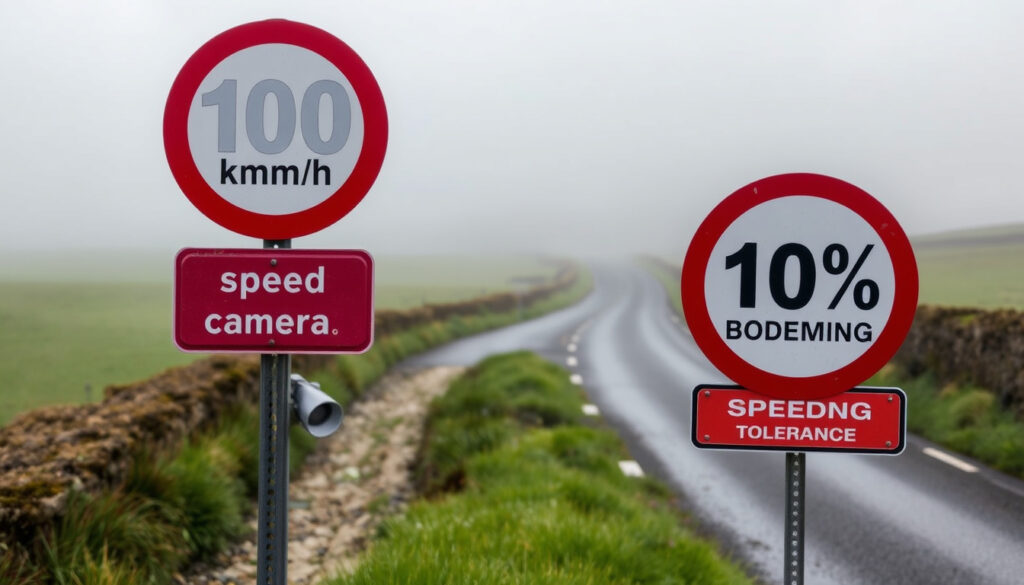
You Will Only Get a Speeding Ticket If 10% Over Limit? Ireland Myth
If you’ve spent any time on Irish roads—or in driving forums—you’ve probably heard the rule of thumb: push 10% over the limit and you’re fine. The idea sounds reasonable, like a built-in buffer. The only problem is there’s no firm evidence it actually exists in the Republic of Ireland. With speed limits across the country changing as of February 2025, now is a good moment to separate what drivers believe from what the law actually says.
Fixed charge fine for speeding: €160 ·
Penalty points for speeding: 3 points ·
Payment window for fine: 28 days ·
Speeding myth tolerance: No 10% rule ·
Common speed limit exceedance fine: Any amount over limit
Quick snapshot
- Exact calibration details for individual speed cameras remain unpublished
- Whether enforcement thresholds vary by Garda division
- Rural local roads dropped to 60 kph on 7 February 2025 (RAC Drive)
- Urban cores expected to shift to 30 kph later in 2025 (RAC Drive)
- Fine notices typically arrive within 14 days (RAC Drive)
- Unpaid fines rise to €240 after 28 days (RAC Drive)
The table below summarizes the key financial and administrative penalties for speeding offences in Ireland.
| Detail | Value |
|---|---|
| Standard speeding fine | €160 |
| Penalty points | 3 |
| Fine payment deadline | 28 days |
| Tolerance myth status | False in Ireland |
| Motorway limit | 120 kph |
| National roads limit | 100 kph |
| Towing vehicle limit | 80 kph |
| Unpaid fine increase | €240 |
| Court max fine | €1,000 |
| Notice delivery window | Within 14 days |
Can you go 10% plus 2 over the speed limit?
The short answer is no—not in the Republic of Ireland. The “10% plus 2” rule has its origins in UK police guidance, where officers are advised to take enforcement action when speeds exceed the limit by 10% plus 2 mph. Northern Ireland’s Police Service (PSNI) has explicitly stated that this tolerance varies and can change without notice, debunking the myth even in that jurisdiction.
For Irish drivers, there is no comparable official discretion. RAC Drive notes that while UK police have guidelines suggesting leeway, “there isn’t any firm evidence that a similar discretion applies in Ireland.” The Road Safety Authority Ireland and Garda Síochána have not published any equivalent tolerance threshold.
Origin of the 10% plus 2 myth
- The 10% plus 2 mph guideline originates from UK police policy, not Irish law
- It was designed as an enforcement guideline, not a legal entitlement
- Drivers in Northern Ireland have reported confusion, prompting PSNI to address the myth directly
Why it does not apply in Ireland
- No Irish government body has endorsed a tolerance threshold
- Speed limits in Ireland are set by bye-laws through local authorities, following official guidelines
- Drivers fined at speeds technically within 10% of the limit have documented their cases in public forums, suggesting enforcement does occur at lower exceedances
Ireland has no published tolerance buffer. Treating the UK guideline as gospel could cost Irish drivers three penalty points and a €160 fine.
Do speed cameras have a tolerance?
Speed cameras in Ireland do not operate under a publicly disclosed tolerance threshold. Unlike some jurisdictions where camera manufacturers build in a small margin to account for minor speedometer inaccuracies, Irish enforcement lacks this kind of transparency. PSNI confirms that tolerance levels “vary and can change without notice” even in Northern Ireland, where the 10% plus 2 rule is sometimes presumed to apply.
Speed camera thresholds in Ireland
- Cameras can trigger at any speed above the posted limit
- There is no fixed percentage buffer applied to camera readings
- Garda Síochána can position cameras immediately after speed limit signs if the installation is visible and approved
UK vs Ireland differences
- UK police guidelines suggest 10% plus 2 mph leeway, but this remains a guideline rather than law
- Northern Ireland operates under the same myth-debunking approach as the Republic
- Irish drivers crossing the border into Northern Ireland face similar enforcement uncertainty
Speed camera detectors are illegal in Ireland. Garda Síochána actively enforces against drivers who use them.
How many km over the speed limit to get a fine in Ireland?
There is no minimum exceedance threshold for receiving a fine in Ireland. Any amount over the posted limit can trigger a fixed charge notice. The standard fixed charge is €160, accompanied by 3 penalty points on your licence. This applies regardless of whether you were 1 kph or 30 kph over the limit.
Fixed charge thresholds
- No minimum exceedance required for a fine to be issued
- Fines are issued by post, typically within 14 days of the offence
- If unpaid after 28 days, the fine increases to €240 and may add 5 penalty points
Penalty variations by speed
- Low-level exceedances still result in the €160 fixed charge
- Excessive speed or non-payment can escalate to court, with maximum fines of €1,000
- Repeat offenders or severe cases may face further action
Even 2 kph over the limit can theoretically result in a fine and points. The lack of a published tolerance means there is no safe margin to rely on.
Will a speed camera flash at 42 in a 40?
Yes—a speed camera can flash at 42 in a 40 zone. Without a publicly disclosed tolerance threshold, any exceedance carries risk. Camera systems are calibrated to record speeds accurately, and anecdotal reports from Irish drivers suggest that minor exceedances do result in fines. A driver reported being fined at 89 kph in an 80 kph zone, demonstrating that enforcement can occur at relatively small margins above the limit.
Real-world trigger examples
- Drivers have received fines for speeds like 89 kph in an 80 kph zone
- Camera enforcement can begin immediately after speed limit signage if visible to oncoming traffic
- Speed limits near schools may apply only during specific days and times
What to do if flashed
- Check your post regularly—the notice typically arrives within 14 days
- If you receive a fixed charge notice, you have 28 days to pay at the discounted rate of €160
- Failure to pay within 28 days results in a €240 fine and potential escalation
Drivers who accumulate 12 penalty points within three years face a licence disqualification. Three points from a single speeding offence may seem minor, but they add up quickly.
What’s the best defense for a speeding ticket?
The most practical “defense” is to pay the fine promptly. If you pay within the 28-day window, the charge remains at €160 and you receive 3 penalty points. Challenging a ticket requires going to court, where a conviction can result in fines up to €1,000. For most drivers, paying early is the straightforward route.
Payment options for reduction
- Pay within 28 days: €160 fixed charge plus 3 points
- Pay after 28 days: €240 fixed charge plus 5 points
- Court appearance: potential fine up to €1,000 and further penalty implications
Challenging the ticket steps
- Review the notice carefully for accuracy of vehicle details and speed recorded
- Consult with a solicitor if you believe there are grounds for challenge (e.g., camera malfunction, signage issues)
- Attend court if you decide to contest—be prepared with evidence such as photographs of road conditions or signage
- Note that the burden of proof in court may rest on the prosecution
Ireland’s current speed limits: a quick guide
With the February 2025 changes, several speed limits have been adjusted. Rural local roads dropped from 80 kph to 60 kph, making it easier to inadvertently exceed the limit if you’re not paying attention. National secondary roads are expected to follow with a reduction from 100 kph to 80 kph, though no confirmed date has been set as of publication.
- Motorways: 120 kph
- National primary roads: 100 kph
- National secondary roads: expected reduction to 80 kph (date TBC)
- Regional and local roads (rural): 60 kph since 7 February 2025
- Built-up areas: 50 kph
- Urban cores: 30 kph (planned for later 2025)
- Vehicles towing trailers or caravans: 80 kph on all roads including motorways
Speed limits in Ireland are posted in kilometres per hour. UK visitors must convert their speedometer readings from miles per hour to avoid unintentional exceedances.
How Ireland compares to Northern Ireland
For drivers crossing the border, understanding the differences matters. Northern Ireland’s NIDirect service reports that fixed penalties are £60 with 3 points—cheaper than the Irish €160 charge, but enforcement policies differ. Speed awareness courses are available in Northern Ireland for minor excesses (such as up to 42 mph in a 30 mph zone), but offenders with 9 or more existing points or excessive speeds are ineligible.
- Republic of Ireland: €160 fine, 3 points, no tolerance
- Northern Ireland: £60 fixed penalty, 3 points, varying tolerance levels
- Northern Ireland courts may impose fines up to £1,000 for serious offences
The pattern is consistent across both jurisdictions: the 10% rule is a guideline that police may or may not apply, not a legal protection for drivers.
“Although police officers in the UK are advised to take enforcement action when speed limits are exceeded by 10% plus 2mph, there isn’t any firm evidence that a similar discretion applies in Ireland.”
— RAC Drive (Motoring Expert)
“Myth: The threshold for speeding is 10% +2mph, so I can travel at 35mph in a 30mph limit. Fact: Tolerance levels vary and can change without notice.”
— PSNI (Police Service of Northern Ireland)
Related reading: Budget Direct car insurance review · Cash for cars Brisbane
Frequently asked questions
How to check if you got caught speeding in Ireland?
If a speed camera recorded your vehicle, you will receive a fixed charge notice by post at the vehicle’s registered address. Notices are typically issued within 14 days of the offence. Keep an eye on your post during this window.
How long does it take to get penalty points in the post Ireland?
Fixed charge notices, including the accompanying penalty points, are typically posted within 14 days of the speeding offence. If you do not receive a notice within a month of a potential infraction, it is unlikely that one will be issued.
How to avoid penalty points for speeding Ireland?
There is no mechanism to avoid penalty points once a fixed charge notice is issued. Paying promptly keeps the fine at €160 and the points at 3. Challenging the ticket requires a court appearance, where the outcome is uncertain and costs can escalate significantly.
Do you get penalty points for no tax?
No tax and no insurance are separate offences from speeding. These violations carry their own penalties and penalty points. Driving without tax or insurance can result in vehicle seizure, fines, and potential court action.
What speed will trigger a speed camera?
Any speed above the posted limit can potentially trigger a camera. There is no published minimum exceedance threshold. Camera systems are calibrated to measure speed accurately, and enforcement can occur at any margin above the limit.
How do I get a 50% discount on fines?
The discounted rate is not a 50% reduction but rather the standard fixed charge of €160 if paid within 28 days. After 28 days, the fine increases to €240. There is no further reduction available.
Is 10% plus 2 still a thing?
In the Republic of Ireland, it was never officially a thing. In Northern Ireland and the UK, it remains a police guideline rather than a legal right, and the PSNI explicitly states that tolerance levels can vary and change. No driver should treat it as a guaranteed buffer.
More related posts
 Vaibhav Suryavanshi: Age, IPL Salary, Family & Career Facts
 Puss in Boots: Character, Movies, Meaning, and More
 Pia Miller: Biography, Age, Ex-Husband, and Career
 RACV Royal Pines Resort – Gold Coast Golf, Facilities and Booking Guide
 Hell or High Water – Meaning, Origins & Movie Guide
 Zootopia 2 Showtimes – Theater Times Tickets and Streaming Dates
 Perth Scorchers vs Adelaide Strikers: BBL Scorecard & FAQ
 James Brolin: Age, Net Worth, Family, and Career Details
