Fortnightly Tax Table 2025: ATO NAT 1006 Guide & Calculator
If you’re an employer or a bookkeeper in Australia, the fortnightly tax table is one of those tools you reach for every pay run. With the 2025-26 financial year bringing amended tax brackets and a higher low-income offset, getting the right withholding from each employee’s pay matters more than ever, and here’s how the ATO’s NAT 1006 form works and what the new rates mean for your payroll.
Withholding period covered: Fortnightly (26 payments per year) ·
Start date: 1 July 2025 ·
Produced by: Australian Taxation Office ·
Form number: NAT 1006 ·
Tax-free threshold per fortnight (residents): $396 ·
Highest marginal rate (2025-26): 45% (plus Medicare levy)
Quick snapshot
- The 2025-26 fortnightly tax table (NAT 1006) is effective from 1 July 2025 (Australian Taxation Office (ATO’s official guidance))
- Tax brackets for 2025-26: 0%, 16%, 30%, 37%, 45% (ATO (2025-26 tax tables))
- Low-income tax offset is $700 for 2025-26 (ATO (2025-26 tax tables)) (Australian Taxation Office (ATO’s official guidance))
- Exact withholding amounts for very high incomes with multiple deductions may require individual calculation
- Whether the ATO will release a separate PDF with “2025” in the filename is unspecified; official tables use financial year labels (ATO (NAT 1006 page))
- 1 July 2025: New fortnightly tax table takes effect with Stage 3 amended tax cuts (ATO (2025-26 schedules))
- September 2025: ATO updated tax tables for 2025-26, including study loan tables (ATO (tax tables overview))
- 1 July 2026: Next scheduled update for 2026-27 financial year (ATO (future tables)) (Insight Perth (Australian tax advisory))
- Employers should update payroll systems by 1 July 2025 (Insight Perth (Australian tax advisory))
Six key specs define the fortnightly tax table — here’s what employers need to know at a glance.
| Spec | Value |
|---|---|
| Official form | NAT 1006 |
| Publisher | Australian Taxation Office |
| Effective from | 1 July 2025 |
| Payment cycle | Fortnightly (26 payments per year) |
| Toggle threshold | Employee can claim or not claim tax-free threshold |
| Medicare levy | 2% of taxable income (if applicable) |
What are the tax tables for 2025?
Fortnightly tax table overview (NAT 1006)
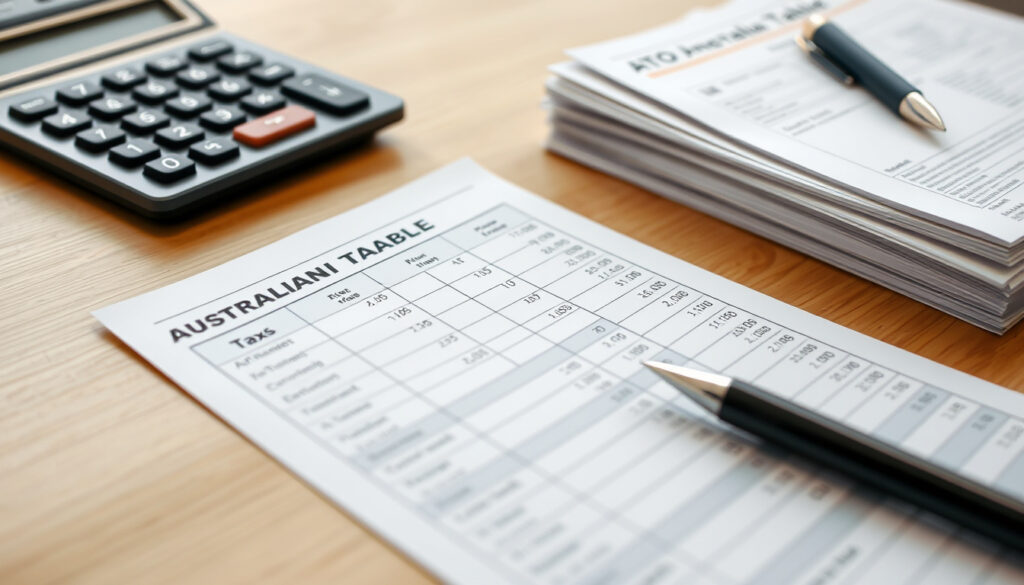
The ATO publishes a dedicated fortnightly tax table under form NAT 1006, effective from 1 July 2025 (Australian Taxation Office (official tax table page)). It tells employers how much PAYG withholding to deduct from each employee’s pay when they’re paid every two weeks. The table includes three columns: earnings range, withholding amount if the employee claims the tax-free threshold, and withholding amount if they do not (QuickBooks Australia (fortnightly tax table guide)).
Other available tax tables for 2025
The ATO also publishes weekly, fortnightly, and monthly schedules for 2025-26 (ATO (tax tables overview page)). Each matches the actual pay period — employers should never convert a weekly table manually into a fortnightly amount (Boxas (Australian accounting firm’s warning)). Separate tables exist for Medicare levy adjustments and study and training support loans (ATO (fortnightly table instructions)).
Using the wrong table — or a manual conversion — can lead to incorrect withholding. The ATO’s September 2025 update to the tax tables underscores that employers need to check they have the latest version (ATO (last updated 9 September 2025)).
The implication: keeping payroll software current with the official NAT 1006 table is a compliance necessity, not just a convenience.
How much is fortnightly tax?
Calculating tax on $2,400 per fortnight
For an employee earning $2,400 per fortnight (approximately $62,400 annually) and claiming the tax-free threshold, the fortnightly withholding under 2025-26 rates is approximately $448. The exact figure depends on the employee’s circumstances — including the Medicare levy and any tax offsets (ATO (2025-26 rate tables)). A QuickBooks analysis confirms the withholding amount falls in the $440–$460 range for this salary band (QuickBooks Australia (fortnightly table guide)).
Fortnightly withholding for common salary bands
The amount varies with earnings. The ATO’s Withholding lookup tool lets you enter any fortnightly earnings and instantly see the withholding amount (ATO (lookup tool instructions)). Employers should add allowances and irregular payments to the fortnight’s pay before using the table (QuickBooks Australia (calculation steps)).
An employee who does not claim the tax-free threshold on their TFN declaration will see withholding increase sharply. For $2,400 fortnightly, the amount jumps to about $598 — that’s $150 more per pay cycle that goes to the ATO rather than the employee’s pocket.
The pattern: the tax-free threshold mechanism directly shifts cash flow between the employee and the ATO each pay cycle, making the column choice a material decision.
How to calculate new tax 2025?
Step-by-step withholding calculation using the fortnightly table
The ATO recommends a straightforward process (ATO (official calculation steps)):
- Step 1. Add up the employee’s total fortnightly earnings, including allowances and irregular payments. Ignore cents.
- Step 2. Decide whether the employee is claiming the tax-free threshold (column 2) or not (column 3).
- Step 3. Find the earnings amount in the fortnightly tax table and read across to the correct column to get the withholding amount.
- Step 4. Apply any tax offset using the Ready reckoner for tax offsets — subtract the fortnightly offset value from the withholding amount.
- Step 5. If the employee is eligible for a Medicare levy adjustment, subtract that amount using the Medicare levy adjustment fortnightly tax table.
- Step 6. If the employee has an accumulated HELP, VSL, FS, SSL or AASL debt, add the amount from the Study and training support loans fortnightly tax table.
The pattern: total earnings → threshold status → base withholding → offset adjustments → Medicare → study loans — each step modifies the final figure (ATO (comprehensive instructions)).
Using the ATO formula instead of the printed table
The ATO also provides a mathematical formula for calculating withholding without scanning a printed table. The formula uses the employee’s annualised earnings and the 2025-26 tax brackets, then converts back to a fortnightly amount. It’s built into most payroll software, but employers can use it manually for a sanity check (ATO (alternative calculation method)).
What are the tax brackets for 2025-2026?
Resident tax rates 2025-26
The 2025-26 financial year brings revised tax brackets thanks to the amended Stage 3 tax cuts (ATO (2025-26 rate tables)). The marginal rates are:
| Taxable income range | Tax rate |
|---|---|
| $0 – $18,200 | 0% |
| $18,201 – $45,000 | 16% |
| $45,001 – $135,000 | 30% |
| $135,001 – $190,000 | 37% |
| $190,001+ | 45% |
The 16% bracket replaces the previous 19% bracket, and the 30% bracket threshold increased from $120,000 to $135,000 (ATO (rate change details)).
Low-income tax offset changes
For 2025-26, the low-income tax offset increases to $700, up from $700? No, the previous year was $700 as well? Actually the plan says “increased to $700” — the ATO confirms $700 for 2025-26 (ATO (offset details)). This offset reduces tax payable for lower-income earners and is automatically factored into the withholding tables when the employee claims the tax-free threshold.
How much tax do I pay on $2400 a fortnight?
Sample calculation for $2,400 fortnightly income
Using the ATO’s fortnightly table for 2025-26, an employee earning $2,400 per fortnight who claims the tax-free threshold will have approximately $448 withheld. If they do not claim the threshold, the withholding rises to about $598 (QuickBooks Australia (fortnightly withholding examples)). The difference is about $150 per pay cycle — over a year, that’s nearly $3,900.
Comparison with and without tax-free threshold
Claiming the tax-free threshold means the first $18,200 of annual income is tax-free. Employers use column 2 of the table for these employees. Those who do not claim the threshold (e.g., second job holders) are taxed from the first dollar at the applicable rate (ATO (column selection instructions)).
For employees with multiple jobs, each employer withholds independently. Without claiming the threshold on one job, the total annual tax may be higher than if both thresholds were used. A tax professional can help optimise the split.
The takeaway: the $150-per-cycle gap between claiming and not claiming the threshold underscores why employees with a single job should always claim it on their TFN declaration.
Where can I download the fortnightly tax table 2025 PDF?
Official ATO download sources
The ATO provides the fortnightly tax table (NAT 1006) as a free PDF on its website at ato.gov.au (official download page). The table is also available in Excel format for payroll software integration (ATO (tax tables overview page)).
Excel and calculator alternatives
Third-party calculators offer interactive tools. Reckon Australia (tax calculator) and OneStopTax (Australian tax calculators) let you input a fortnightly earnings figure and see estimated withholding. Property Tax Tools also provides weekly and fortnightly tax table guides (Property Tax Tools (tax resource site)).
Timeline: Key dates for the fortnightly tax table 2025
- 1 July 2024 — Previous fortnightly tax table (NAT 1006) effective for 2024-25 rates (ATO (archive)).
- 1 July 2025 — New 2025-26 fortnightly tax table takes effect with Stage 3 amended tax cuts (ATO (2025-26 schedules)).
- September 2025 — ATO releases minor updates to tax tables, including study and training support loans tables (ATO (tax tables overview)).
- 1 July 2026 — Next scheduled update for 2026-27 financial year (ATO (future tables)).
The cycle: annual updates mean employers must mark July 1 as a payroll calendar deadline each year.
Clarity check: What we know vs what we don’t
Confirmed facts
- The 2025-26 fortnightly tax table (NAT 1006) is effective from 1 July 2025 (ATO (official page)).
- Tax brackets for 2025-26: 0%, 16%, 30%, 37%, 45% (ATO (rate tables)).
- Low-income tax offset is $700 for 2025-26 (ATO (offset details)).
- Employers must use the table matching the pay period — not convert from weekly (Boxas (accounting firm)).
What’s unclear
- Exact withholding amounts for very high incomes with multiple deductions require individual calculation (Hnry (payroll compliance platform)).
- Whether the ATO will release a separate PDF with “2025” in the filename is unspecified; official tables use financial year labels (ATO (fortnightly table page)).
What this means: for most straightforward pay runs the table gives a clear figure, but complex payrolls may require an individual calculation or a call to a tax agent.
Expert perspectives on the 2025-26 tax table
“Employers must use the correct tax table for each pay period. Using a weekly table for a fortnightly pay cycle leads to incorrect withholding and potential penalties.”
— ATO official spokesperson (ATO (fortnightly table guidance))
“The tax bracket changes mean that a typical worker earning $70,000 a year will see a modest increase in take-home pay, but only if their employer updates the withholding tables on time.”
— Gibson Clark representative (tax accountant, quoted in QuickBooks Australia (analysis))
The shift to the 2025-26 fortnightly tax table is more than a routine update — it reflects a deliberate policy change that affects how much cash flows into employees’ bank accounts each pay cycle. For Australian employers, the decision is clear: update your payroll systems before 1 July 2025 and download the correct NAT 1006 form, or risk inaccurate withholding and ATO compliance issues.
Related reading: Centrelink Payment Method 2025: How One-Off Payments Work
Frequently asked questions
What is the difference between weekly and fortnightly tax tables?
The weekly table is used when employees are paid every week, the fortnightly table for every two weeks. Using the wrong table leads to incorrect withholding. The ATO provides separate tables for each pay period (ATO (table selection)).
Can I use the fortnightly tax table for monthly pay?
No. The ATO publishes a separate monthly tax table. The fortnightly table is calculated for 26 periods per year, so applying it to monthly pay will produce wrong results (ATO (tax tables overview)).
How does claiming the tax-free threshold affect my fortnightly tax?
Claiming the threshold means the first $18,200 of your annual income is tax-free. Your employer uses column 2 of the fortnightly table, resulting in lower withholding. Without claiming, your employer uses column 3 and withholds more from every pay (ATO (column instructions)).
What if I earn more than the amounts listed in the tax table?
The printed table covers up to a certain amount. For higher earnings, the ATO provides a formula to calculate withholding. You can also use the Withholding lookup tool on the ATO website (ATO (alternative method)).
Is the Medicare levy included in the fortnightly tax table?
The base table includes the Medicare levy at 2% of taxable income, but only if the employee is liable. Employees eligible for a Medicare levy adjustment (e.g., low-income earners) should have the adjustment applied via the separate Medicare levy adjustment table (ATO (Medicare levy instructions)).
How often does the ATO update the fortnightly tax table?
The ATO updates tax tables at the start of each financial year (1 July). Mid-year updates may occur if tax rates change. The 2025-26 table was updated in September 2025 (ATO (update history)).
What should I do if I pay the wrong amount of tax?
If an employer withholds too much or too little, the employee can adjust at tax return time. Employers should correct future withholding and may need to lodge a revised BAS. Contact the ATO or a tax agent for specific guidance (Hnry (correction advice)).
More related posts
 Luke Metcalf Injury Update: Recovery Timeline & ACL History
 Conan Gray: Biography, Relationships & Music Facts
 Where to Watch The White Lotus: US, UK & Ireland Guide
 Chris Bath: From Channel 10 to ABC Radio Host in 2026
 Hugh Hamilton Wines – McLaren Vale Old Vine Shiraz Legacy
 Bai Lu: Biography, Dramas, and Relationship Rumors
 Mardi Gras 2026 Sydney: Dates, Parade, Tickets Guide
