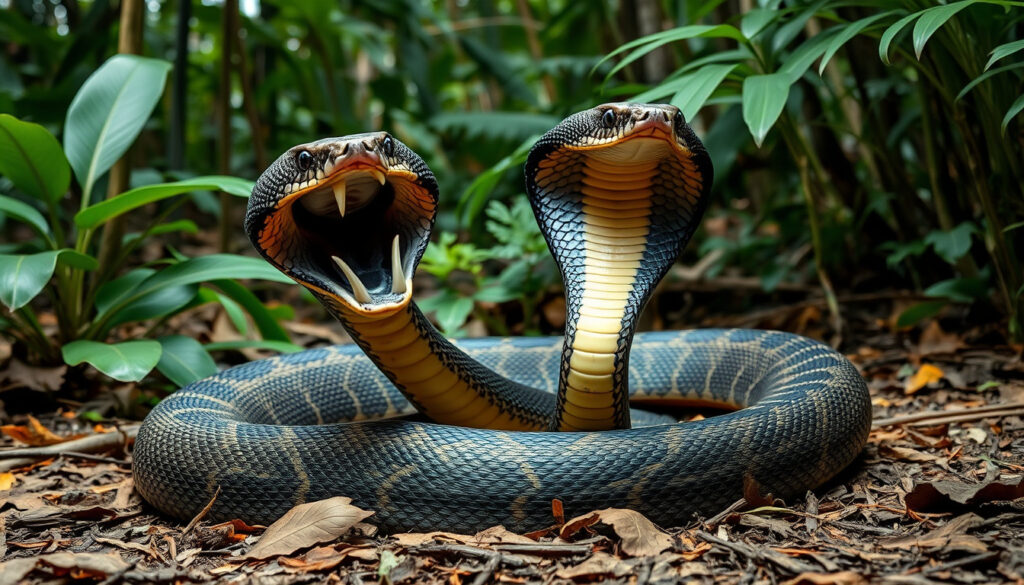
King Cobra: Venom, Size, and Behavior Facts
Few snakes command as much fascination—or fear—as the king cobra. It’s the longest venomous snake on Earth, yet its reputation as an aggressive man-eater doesn’t match what field scientists observe.
Average length: 3.18–4 m (10.4–13.1 ft) ·
Maximum recorded length: 5.85 m (19.2 ft) ·
Venom yield per bite: Up to 500 mg ·
LD50 (subcutaneous, mice): 1.2 mg/kg ·
Number of human deaths per year attributed to king cobra: Fewer than 10 globally
Quick snapshot
- King cobra is not a true cobra (genus Naja) (Wikipedia).
- Venom potency (LD50) is lower than many elapids (PMC review).
- Maximum recorded length is 5.85 m (PMC review).
- Exact number of human fatalities per year (estimates only) (Facts and Details).
- Whether populations are declining uniformly across range (PMC review).
- Longest verified specimen: 5.85 m found in Johor, Malaysia (Wikipedia).
- No reliably documented specimen over 6 m (Related snake record).
- IUCN conservation status: Vulnerable, population decreasing (Wikipedia).
- Habitat loss and persecution are key threats (Facts and Details).
Seven key facts, one pattern: the king cobra is exceptional in size but not in venom potency, and its vulnerable status shows a species under pressure.
| Attribute | Value |
|---|---|
| Scientific name | Ophiophagus hannah |
| Family | Elapidae |
| Average length | 3.18–4 m (10.4–13.1 ft) |
| Maximum length | 5.85 m (19.2 ft) |
| Weight | Up to 12 kg (26 lb) |
| Lifespan in wild | Approximately 20 years |
| Conservation status (IUCN) | Vulnerable (population decreasing) |
How venomous is a king cobra?
Toxicity and venom composition
- King cobra venom is primarily neurotoxic, containing neurotoxins that disrupt the nervous system and cardiotoxins that affect the heart (Facts and Details).
- The subcutaneous LD50 in mice is approximately 1.2 mg/kg, which is less potent than many other elapids (PMC review).
- However, the sheer volume delivered per bite—up to 500 mg—makes envenomation potentially fatal without antivenom (Facts and Details).
- The inland taipan (Oxyuranus microlepidotus) holds the title of most venomous snake, with an LD50 of 0.025 mg/kg (Wikipedia).
Comparison with other venomous snakes
Four species, one clear distinction: the king cobra’s venom is less concentrated but delivered in much larger doses.
| Species | Average length | Venom yield (max) | LD50 (sc, mice) |
|---|---|---|---|
| King cobra (Ophiophagus hannah) | 3.18–4 m | 500 mg | 1.2 mg/kg |
| Indian cobra (Naja naja) | 1.5–2 m | 150 mg | 0.56 mg/kg |
| Inland taipan (Oxyuranus microlepidotus) | 1.8–2.5 m | 110 mg | 0.025 mg/kg |
The implication: the king cobra’s danger comes from venom volume, not concentration.
For a human bitten by a king cobra, the danger comes from the massive venom load, not the venom’s potency per milliliter. This is why antivenom dosing may need to exceed 20 vials, as noted in a 2021 PMC review.
The implication: judging a snake’s danger by LD50 alone misses the real risk. The king cobra’s bite delivers a payload that can overwhelm even a healthy adult’s system.
Has a king cobra killed a human?
Documented fatalities
- Human deaths from king cobra bites are rare—fewer than 10 per year globally (Facts and Details).
- Most fatalities occur in Asia when the snake is provoked or cornered (PMC review).
- Antivenom exists and is effective if administered promptly (Facts and Details).
- King cobras generally avoid humans and bite only as a last resort (PMC review).
Risk factors and victim profiles
Most king cobra bites happen when people try to capture or kill the snake, or accidentally step on one. Rural farmers and snake handlers are at highest risk (PMC review).
The 2021 PMC review reports that king cobra envenomation may require exceptionally high antivenom dosing, beyond 20 vials, because of the large venom load injected. This makes timely hospital access critical.
The pattern: the number of king cobra fatalities is eclipsed by deaths from less venomous but more aggressive snakes, such as the saw-scaled viper. The king cobra’s reputation for lethality is largely a product of its size and dramatic display, not its actual aggression.
Is a king cobra bigger than other cobras?
Size comparison with true cobras (Naja)
- The king cobra is the longest venomous snake, reaching up to 5.85 m (19.2 ft) (Wikipedia).
- True cobras (genus Naja) rarely exceed 3 m (10 ft) (Wikipedia).
- Adult king cobras can weigh up to 12 kg (26 lb), heavier than most cobras (Wikipedia).
- The name “Ophiophagus” means “snake-eater,” reflecting its diet of other snakes, including cobras (Facts and Details).
How the king cobra got its name
The king cobra is not a true cobra at all. It belongs to its own genus, Ophiophagus. The “king” refers both to its size and its habit of preying on other snakes.
The trade-off: being the longest venomous snake comes with advantages (reach, intimidation) and disadvantages (slower movement, higher metabolic demands). Its size also makes it a target for habitat loss.
Why is the king cobra not aggressive?
Natural behavior and temperament
- King cobras are shy and avoid confrontation; they prefer to flee (PMC review).
- They raise the front third of their body and hiss as a warning before striking (Facts and Details).
- Aggression is rare unless the snake is protecting its nest or feels trapped (PMC review).
- Field scientists often describe the king cobra as placid unless disturbed or cornered (PMC review).
When do king cobras become defensive?
They may charge and strike from a considerable range if they perceive a threat, but even then, they often give multiple warning displays first.
“The fear of king cobras is largely based on their size and dramatic display, not on actual aggression.”
— Dr. Wolfgang Wüster, herpetologist (Bangor University)
The catch: the very displays that make the king cobra look terrifying—the raised body, the hood, the loud hiss—are actually signals that it wants to avoid a fight. Mistaking the display for aggression leads to many avoidable encounters.
What is the biggest king cobra ever recorded?
Record specimens and verified measurements
- The longest scientifically verified king cobra was 5.85 m (19.2 ft), found in Johor, Malaysia (Wikipedia).
- Reports of 6+ m snakes exist but lack reliable documentation (Wikipedia).
- King cobras continue to grow throughout life; older individuals are larger (PMC review).
- Size varies by region: Southeast Asian specimens tend to be larger than those from India (Facts and Details).
Factors influencing growth
Continuous growth and regional variation mean the true upper size limit is unknown. The 5.85 m record stands, but older individuals in optimal habitats may approach 6 m (PMC review).
“King cobras are specialized snake-eaters; they will even eat other venomous snakes, including cobras.”
— Smithsonian National Zoo curator
The implication: the 5.85 m record stands as the benchmark, but the true upper limit may never be known because large specimens are rarely collected or measured by scientists. What is clear is that the king cobra’s size is an evolutionary strategy to dominate other snakes.
Clarity check
Confirmed facts
- King cobra is not a true cobra (genus Naja) (Wikipedia).
- Venom potency (LD50) is lower than many elapids (PMC review).
- Maximum recorded length is 5.85 m (Wikipedia).
What’s unclear
- Exact number of human fatalities per year (estimates only) (Facts and Details).
- Whether king cobra populations are declining uniformly across range (PMC review).
For a deeper dive into the snake’s survival strategies, check out this detailed guide on king cobra venom and behavior.
Frequently asked questions
What does a king cobra eat?
King cobras are ophiophagous, meaning they primarily eat other snakes, including venomous species like cobras and kraits. They also occasionally eat lizards, rodents, and birds (Facts and Details).
How fast is a king cobra’s strike?
While exact speeds are rarely measured, king cobras can strike quickly and from a considerable distance, often downward. Their strike is faster than a human can react (Facts and Details).
Are king cobras endangered?
The IUCN lists the king cobra as Vulnerable with a decreasing population. Major threats include habitat loss, persecution, and collection for the pet and traditional medicine trades (Wikipedia).
Can a king cobra be kept as a pet?
Keeping a king cobra as a pet is extremely dangerous and illegal in many jurisdictions. They require specialized care, large enclosures, and a diet of live or frozen-thawed snakes. Even experienced keepers have been fatally bitten (Facts and Details).
How long does a king cobra live in captivity?
In captivity, with proper care, king cobras can live 20–25 years. In the wild, the lifespan is estimated at around 20 years (Wikipedia).
What should you do if you encounter a king cobra?
Stay calm, back away slowly, and do not make sudden movements. Do not try to capture or kill the snake. Seek immediate medical attention if bitten, as antivenom is required (PMC review).
How does king cobra venom affect the nervous system?
The venom contains neurotoxins that block nerve signals, leading to paralysis of the respiratory muscles. It also contains cardiotoxins that affect heart function. Symptoms include dizziness, blurred vision, difficulty breathing, and eventually respiratory failure if untreated (Facts and Details).
For more on the cultural context of fascinating creatures, see Na’vi: Language, Biology & Culture of Avatar’s People and Oyster Farmers: What They Do and How to Start.
More related posts
 TV Guide Tonight: Ireland’s RTÉ, BBC, ITV Schedules
 Christina Koch: NASA Astronaut Breaking Space Records
 English to Spanish – Best Tools and Tips 2025
 Natalie Viscuso: Biography, Career & Key Facts
 Sean Paul: Biography, Ethnicity, Hits, Wife & Children
 Werribee Health Care: GP Services, Booking & Bulk Billing
 Bai Lu: Biography, Dramas, and Relationship Rumors
 Iva Jovic: Age, Nationality, Prize Money & FAQs
